What Are Commodities
Before you can read a market, you need to understand what you're actually trading. Commodities are the raw materials the world runs on — and their prices affect everything.
The raw materials that quietly run your life — and loudly move your margins.
Why Commodities Matter
Every cup of coffee, every smartphone, every bag of chips, every car ride, every electricity bill — none of it exists without commodities. They are the layer underneath the economy. And when this layer twitches, everything above it shakes. As of this week, Brent crude is trading around $107 per barrel, up nearly 62% from the same time last year — and somewhere a paint manufacturer, an airline CFO, and a farmer in Maharashtra are all rewriting their forecasts because of it.
The Core Idea
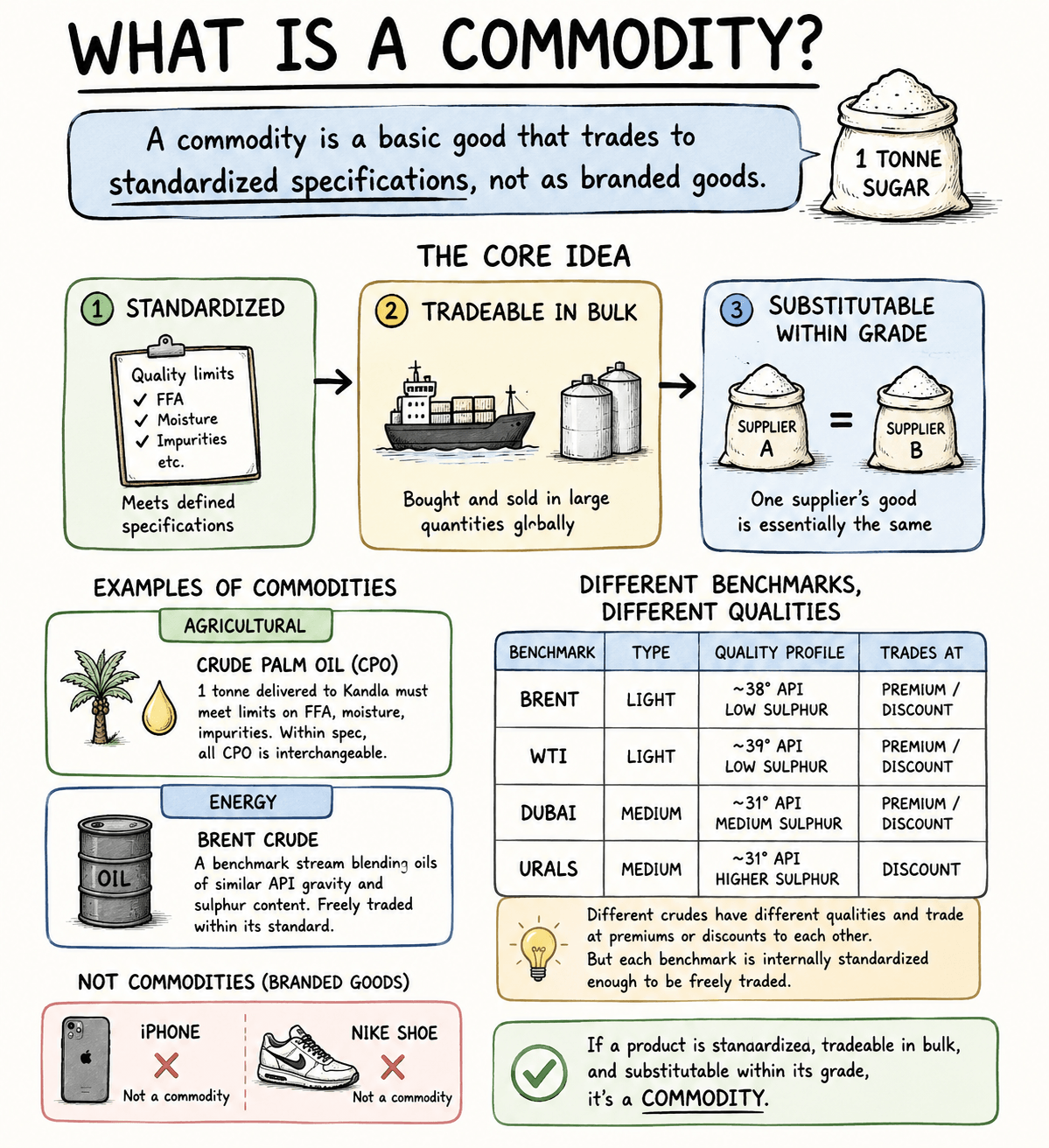
A commodity is a basic good that trades to standardized specifications, not as branded goods. One tonne of crude palm oil (CPO) delivered to Kandla must meet defined limits on free fatty acid (FFA) content, moisture, and impurities — and within those specifications, one supplier's CPO is essentially substitutable for another's. The same is true of Brent crude, which is itself a benchmark stream blending oils of similar API gravity and sulphur content. Different crudes (Brent, WTI, Dubai, Urals) have different qualities and trade at premiums or discounts to each other, but each benchmark is internally standardized enough to be freely traded.
This is what separates commodities from branded products. An iPhone is not a commodity. A Nike shoe is not a commodity. A tonne of refined sugar of a given grade is — regardless of which mill produced it.
If a product is standardized, tradeable in bulk, and substitutable within its grade, it's a commodity.
The Four Families
- Energy — Crude oil (Brent, WTI, Dubai), natural gas, LNG, coal, refined products (diesel, gasoline, jet fuel), ethanol. The arteries of the global economy.
- Metals — Split into base metals (copper, aluminium, zinc, nickel, lead, tin — industrial) and precious metals (gold, silver, platinum, palladium — part industrial, part monetary).
- Agricultural commodities — Grains and oilseeds (wheat, rice, corn, soybeans), plus the meat complex. The plate of the planet.
- Soft commodities — Tropical, climate-sensitive crops grown in narrow geographic bands: coffee, cocoa, sugar, cotton, rubber, orange juice.
Sitting alongside these — and often grouped under agri but worth flagging separately — are edible oils (palm oil, soybean oil, sunflower oil, rapeseed oil), which behave as their own sub-sector because they are simultaneously food and biofuel.
A fifth grouping is emerging: energy-transition and strategic materials — lithium, cobalt, nickel (already a base metal), graphite, rare earth elements, uranium, and tungsten. Some traders also include commodity-adjacent traded environmental instruments such as carbon credits and renewable energy certificates, though their status as true commodities is still debated.
A Day in the Life of a Commodity: Palm Oil from Sumatra to Your Biscuits
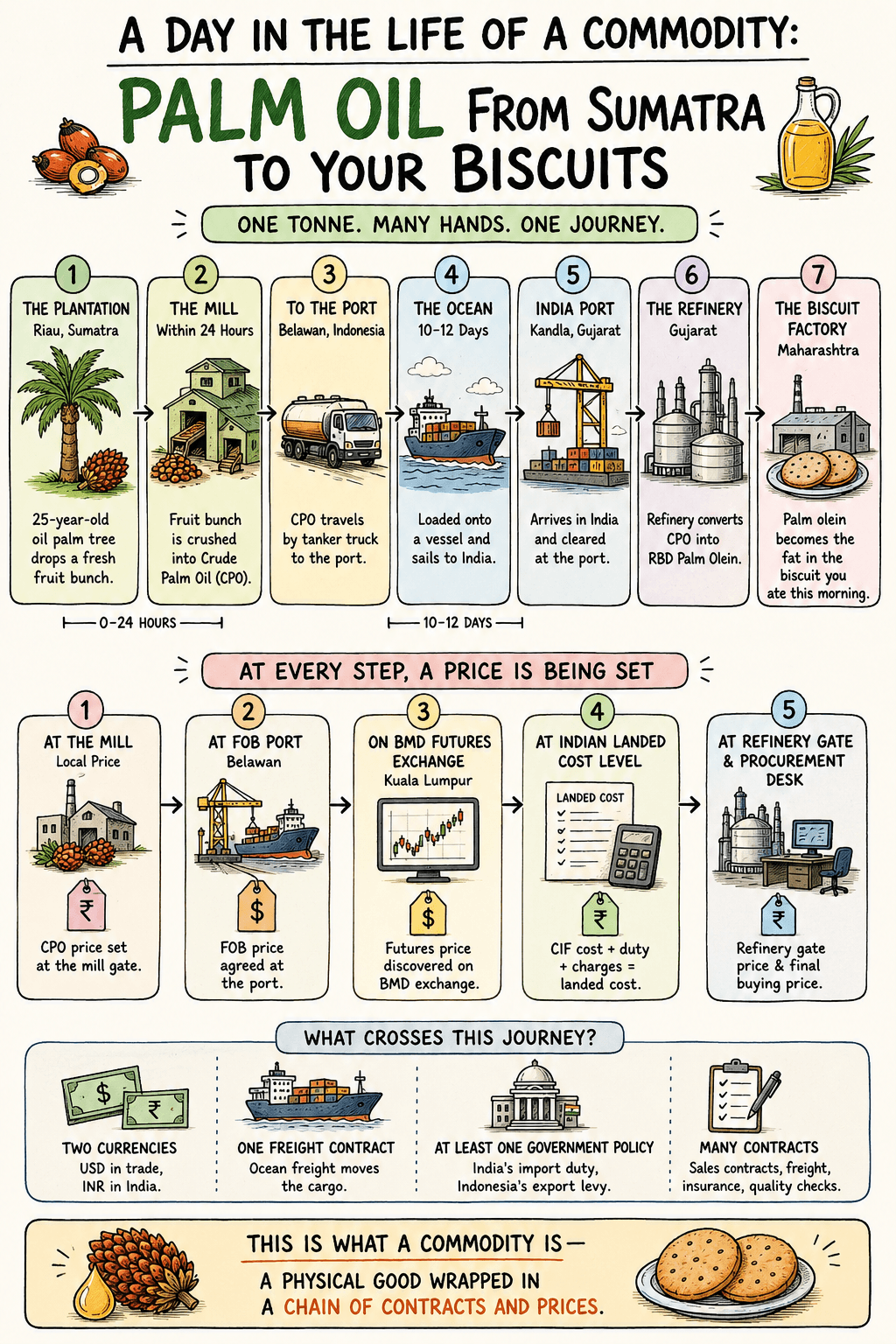
A typical journey: a 25-year-old oil palm tree in Riau province, Sumatra, drops a fresh fruit bunch. Within 24 hours it's at a mill, crushed into Crude Palm Oil (CPO). The CPO travels by tanker truck to a port like Belawan, gets loaded onto a vessel, and sails for roughly 10–12 days to a port like Kandla in Gujarat. There, a refinery converts it into RBD palm olein. From the refinery, it moves to a biscuit factory in Maharashtra, where it becomes the fat in the biscuit you ate with your tea this morning.
At every single step, a price is being set — at the mill, at the FOB port, on the BMD futures exchange in Kuala Lumpur, at the Indian landed-cost level, at the refinery gate, at the procurement desk. By the time the biscuit reaches your kitchen, that one tonne of palm oil has passed through five price points, two currencies, one freight contract, and at least one government policy (India's import duty, Indonesia's export levy).
This is what a commodity is — a physical good wrapped in a chain of contracts and prices.
Spot vs. Futures: What the Price on TV Actually Means
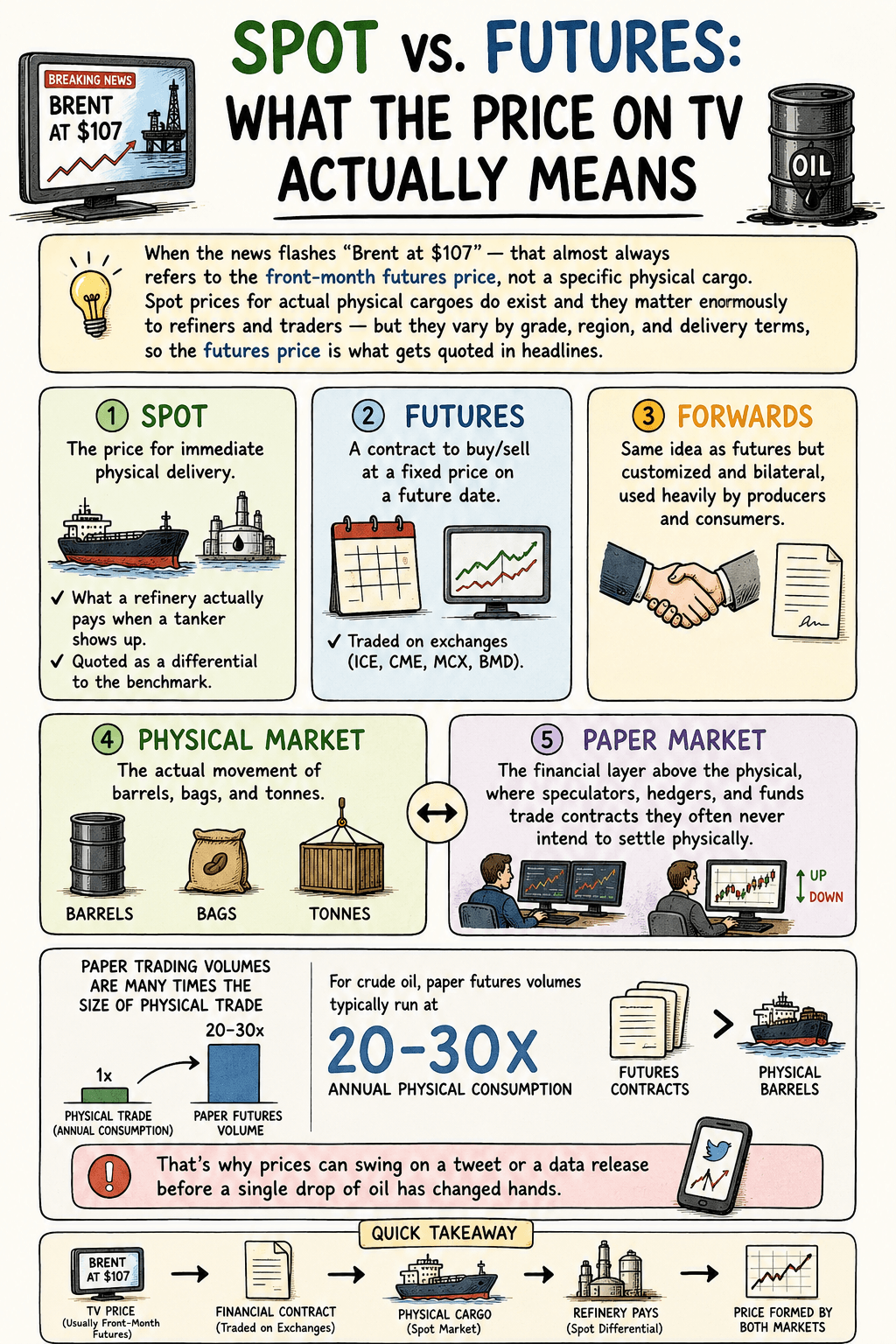
When the news flashes "Brent at $107" — that almost always refers to the front-month futures price, not a specific physical cargo. Spot prices for actual physical cargoes do exist and they matter enormously to refiners and traders — but they vary by grade, region, and delivery terms, so the futures price is what gets quoted in headlines.
- Spot — the price for immediate physical delivery. What a refinery actually pays when a tanker shows up. Quoted as a differential to the benchmark.
- Futures — a contract to buy/sell at a fixed price on a future date. Traded on exchanges (ICE, CME, MCX, BMD).
- Forwards — same idea as futures but customized and bilateral, used heavily by producers and consumers.
- Physical market — the actual movement of barrels, bags, and tonnes.
- Paper market — the financial layer above the physical, where speculators, hedgers, and funds trade contracts they often never intend to settle physically.
Paper trading volumes are many times the size of physical trade — for crude oil, paper futures volumes typically run at twenty to thirty times annual physical consumption. That's why prices can swing on a tweet or a data release before a single drop of oil has changed hands.
Why This Matters in 2026
Look at oil alone this past month. Brent hit $138/barrel on April 7 after the effective closure of the Strait of Hormuz, averaged $117 for April, and is forecast to ease to around $106 through May and June. Iraq, Saudi Arabia, Kuwait, the UAE, Qatar, and Bahrain collectively shut in roughly 10.5 million barrels per day of crude production in April. That is not a market move. That is a re-pricing of the entire global economy in real time.
Meanwhile the UAE formally exited OPEC effective May 1, 2026 — a structural shift that will affect spare capacity and pricing power for years.
This is the world commodities live in.
The Weird, Wonderful, and Unexpected Ripple Effects
The stories nobody tells about how a war 3,000 km away rearranged daily life.
When Hormuz shut, the obvious headlines wrote themselves — oil up, jet fuel up, rupee down. But the interesting story is in the second and third-order effects nobody planned for.
Aluminium and your Coke can
The Gulf states produce about 9% of the world's aluminium supply, and on March 28 an Iranian strike on Emirates Global Aluminium caused massive production disruptions. The damage to Aluminium Bahrain (ALBA, the world's biggest smelter outside China) and Emirates Global Aluminium created a shortage of automotive-grade aluminium for manufacturers including Toyota, Nissan, BMW, and Hyundai. LME aluminium prices surged to $3,258/ton. Suddenly the cost of a Coke can in Europe, a Maruti car body in India, and a window frame in a Dubai high-rise all went up in the same week — because of two specific factories most consumers had never heard of.
The basmati rice paradox
The Middle East drives 70% of Indian basmati demand. The Indian Rice Exporters Federation advised members to stop all fresh shipments because no insurer would cover Gulf-bound vessels. So a Haryana farmer's price collapsed not because of a bad monsoon, but because a marine insurance underwriter in London refused to write a policy.
Bananas rotting at Kandla
Indian banana exports to the Gulf rotted at ports like Kandla because no refrigerated container operator was willing to enter the war zone. Meanwhile, Indian apple and almond imports collapsed because India depends on Iran for 23% of its apples and 39% of its almonds. The result: budget fruit disappeared from Indian markets while premium fruit prices stayed stable — a classic counterintuitive inversion where the poor felt the inflation harder than the rich.
The Gujarat ceramics shutdown
In Gujarat, the gas shortage forced the entire ceramics industry to shut down. In Mumbai, many restaurants closed fully or partially in early March due to the lack of cooking gas. Morbi — the global ceramics capital — went dark not because of demand collapse but because LNG from Qatar stopped flowing. Real estate projects across the Middle East and Africa that relied on Indian tiles suddenly had no supplier.
The induction cooktop boom
With LPG shortages and panic queues at gas stations, urban Indian households scrambled for alternatives. Induction stoves, electric kettles, and electric pressure cookers went out of stock across major e-commerce platforms within ten days of the Hormuz closure. In a single month, India installed piped gas connections to 580,000 new households — a policy response that normally takes a year, compressed into thirty days.
Brazilian soybean farmers, of all people
Brazil is almost entirely dependent on imported fertilizers, with nearly half of its supply transiting the Strait of Hormuz. Brazil accounts for nearly 60% of global soybean exports — a sustained fertilizer shortage could compel farmers to reduce usage, causing a drop in crop yields with significant implications for global food security. So a missile in the Persian Gulf may, six months from now, raise the price of chicken feed in China and tofu in Japan.
Tungsten — the commodity nobody talks about
Tungsten is critical for armor-piercing ammunition, semiconductors, photovoltaics, aerospace, and high-precision manufacturing. China, the largest producer with 80% of world production, restricted exports. Tungsten's price surged over 50% in March 2026 and more than tripled since December 2025. Most people have never bought a gram of tungsten in their lives — but it's now sitting inside the cost structure of every drill bit, every chip, every solar panel.
The marine insurance racket
War-risk ship insurance premiums for the strait jumped from 0.125% to between 0.2% and 0.4% of the ship insurance value per transit. For very large oil tankers, this is an increase of a quarter of a million dollars — per crossing. Lloyd's of London quietly had its best quarter in years. War, for some, is a business model.
The freight rebound nobody saw coming
With Hormuz shut, refiners scrambled for non-Gulf crude — West African, Brazilian, US Gulf Coast. That meant longer voyages, which sucked up tanker capacity, which sent freight rates (VLCC day rates) to multi-year highs. Tanker owners with empty ships in the right ocean made fortunes.
And the rupee
The Indian rupee dropped sharply, crossing 92/USD. Every imported item — phones, laptops, lentils, edible oil, even foreign university tuition fees being remitted by Indian parents — got more expensive in the same week, with no announcement and no warning.
A commodity shock never stays in its lane. Crude moves freight. Freight moves food. LNG moves ceramics. Aluminium moves cars and Coke cans. Tungsten moves semiconductors. And the marine insurance underwriter in London quietly decides whether a Haryana farmer makes a profit this season.
The India Lens
India is one of the most commodity-exposed major economies on earth.
- We import the large majority of our crude oil — roughly 85–88% in recent years. Every $10 move in Brent costs the country roughly $15 billion in import bill.
- We are the world's largest importer of palm oil — about 9 million tonnes a year, primarily from Indonesia and Malaysia.
- We are the largest gold consumer alongside China — gold isn't a luxury here, it's a household savings product.
- Our domestic commodity exchanges are MCX (metals, energy, bullion) and NCDEX (agri).
- The rupee is effectively a commodity-linked currency — when crude rises, the rupee weakens, imported inflation rises, and the RBI starts watching closely.
For an Indian business, "commodity intelligence" is not optional. It is the same as knowing the weather before you go out.
Mini Case Study: How April's Hormuz Shock Hit an Indian Airline
Imagine a mid-sized Indian carrier. Fuel is roughly 35–40% of its operating cost. Going into April 2026, the airline had budgeted Brent at $80/barrel for the quarter.
Then Hormuz shut. Brent ripped to $138 at one point and averaged $117 for the month. Jet fuel prices in India track Brent with a lag of about two weeks. The airline's per-flight fuel cost suddenly jumped by approximately 35–40%.
Three things happened. One, the airline activated existing hedges — but they only covered 30% of consumption, so 70% of the increase hit the P&L directly. Two, ticket prices on India–Gulf routes rose 12–18% within three weeks. Three, the CFO went into emergency mode to renegotiate fuel surcharges with corporate clients.
The point: a geopolitical event 3,000 km away decided whether this airline made or lost money that quarter. The teams who saw it coming — who were monitoring tanker movements, Iranian rhetoric, and Saudi production signals — hedged earlier and softened the blow. The teams who reacted to headlines paid the full price.
That is the difference commodity intelligence makes.
Why You Should Care
- If you trade or invest: Commodities are the cleanest expression of macro themes — war, weather, policy, growth.
- If you run procurement (F&B, FMCG, manufacturing): Your gross margin is decided in Chicago, Kuala Lumpur, London, and Singapore — long before your finance team closes the month.
- If you import or export: Commodity moves drive freight rates, the rupee, and your landed cost.
- If you just want to be a smarter citizen: Inflation, fuel prices at the pump, your edible oil bill, your gold jewellery — all start here.
The Shift in How Commodities Are Read
The old way: wait for the headline, react.
The new way: monitor the underlying signals — vessel positions, inventory drawdowns, weather anomalies, policy whispers, freight rates — and act before the headline. That is the foundation everything else in this masterclass is built on.