Key Sectors: Energy, Metals, Agri & Soft Commodities
Commodities aren't one market — they're four distinct sectors, each with its own logic, participants, and price drivers. Understanding the differences is where commodity literacy begins.
Commodities aren't one market — they're four distinct sectors, each with its own logic, participants, and price drivers. Understanding the differences is where commodity literacy begins.
Why the Sector Matters More Than the Commodity
A copper trader and a coffee trader live in different universes. One is watching Chinese factory data, electrical grid build-outs, and Chilean mine output. The other is watching rainfall in Brazil, frost in Vietnam, and shipping containers from Santos. Same word — "commodity" — completely different game.
Most commodities can be grouped into a practical four-family framework. Each family has its own personality: what drives it, who trades it, how it's stored, how fast it moves, and how it bleeds into the rest of the economy. There are edges and overlaps — electricity, livestock, uranium, and carbon markets often sit in their own buckets — but the four-family model is the most useful starting point. Get the family right, and the rest of commodity intelligence becomes much easier.
1. Energy — The Master Commodity
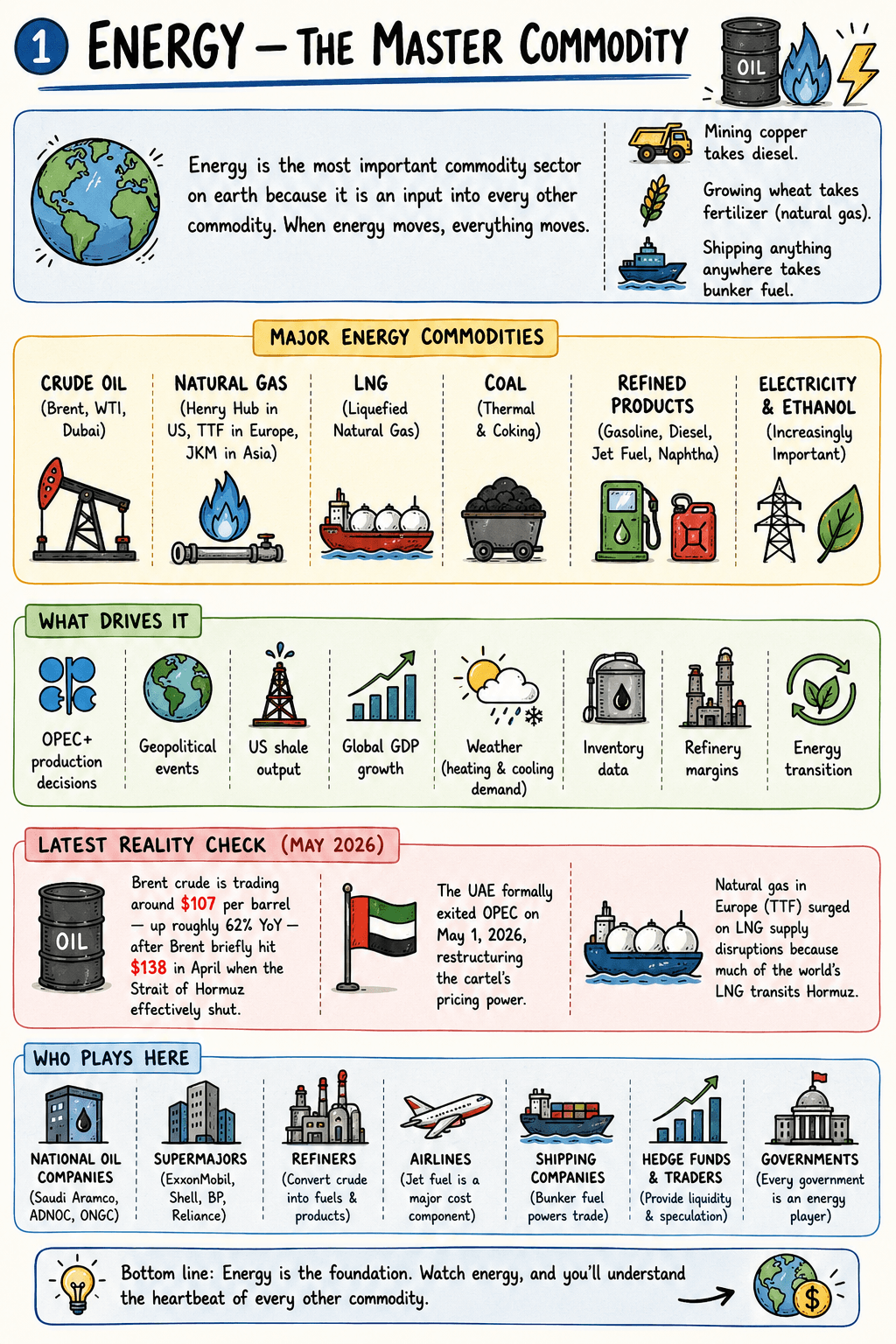
Energy is the most important commodity sector on earth because it is an input into every other commodity. Mining copper takes diesel. Growing wheat takes fertilizer (which takes natural gas). Shipping anything anywhere takes bunker fuel. When energy moves, everything moves.
The major energy commodities are crude oil (Brent, WTI, Dubai), natural gas (Henry Hub in the US, TTF in Europe, JKM in Asia), liquefied natural gas (LNG), coal (thermal and coking), refined products (gasoline, diesel, jet fuel, naphtha), and increasingly electricity and ethanol.
What drives it: OPEC+ production decisions, geopolitical events, US shale output, global GDP growth, weather (heating and cooling demand), inventory data, refinery margins, and increasingly the energy transition.
Latest reality check: Brent crude is trading around $107 per barrel — up roughly 62% year-on-year — after Brent briefly hit $138 in April when the Strait of Hormuz effectively shut. The UAE formally exited OPEC on May 1, 2026, restructuring the cartel's pricing power. Natural gas in Europe (TTF) surged on LNG supply disruptions because much of the world's LNG transits Hormuz.
Who plays here: National oil companies (Saudi Aramco, ADNOC, ONGC), supermajors (ExxonMobil, Shell, BP, Reliance), refiners, airlines, shipping companies, hedge funds, and every government on earth.
2. Metals — Where Industry Meets Geopolitics
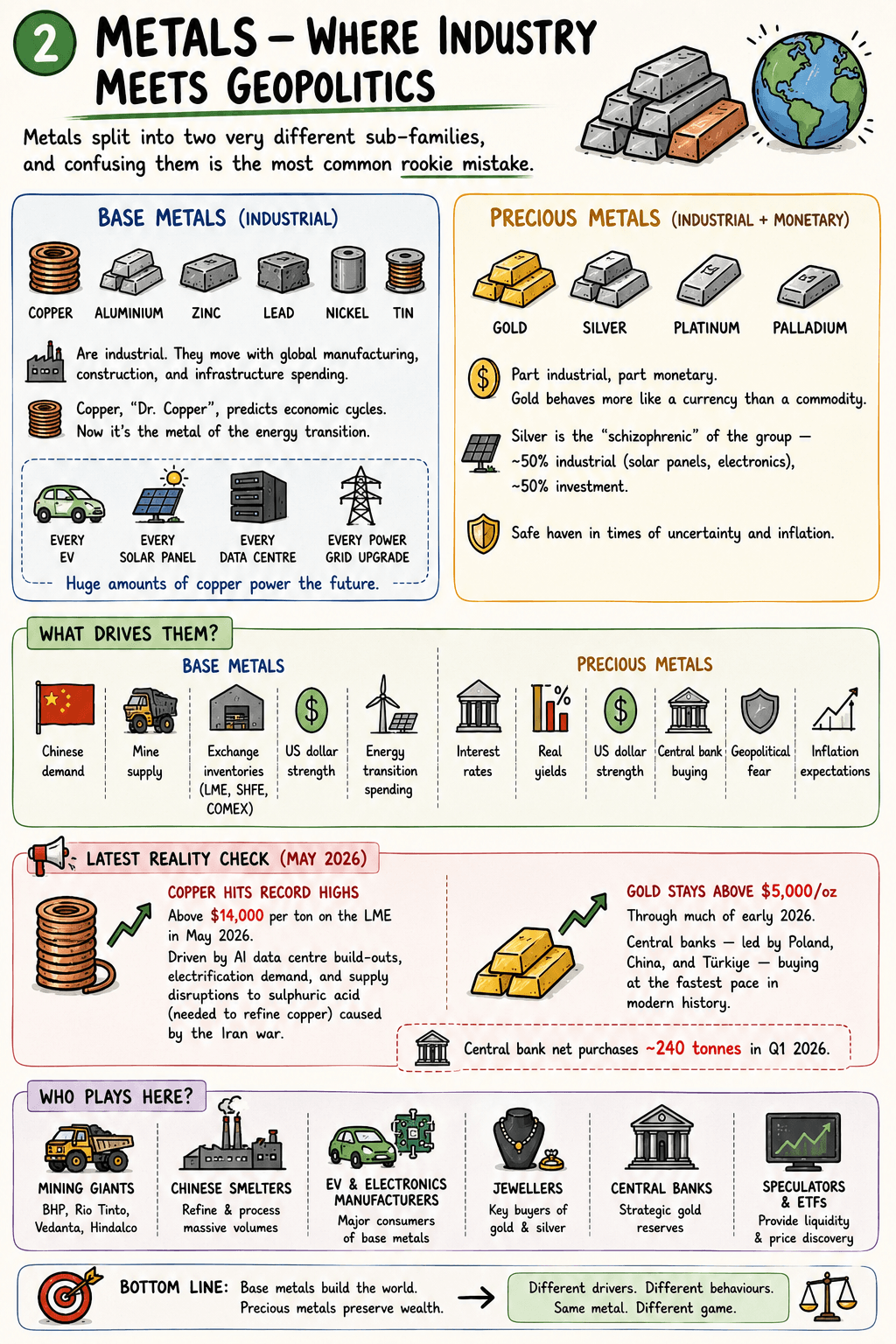
Metals split into two very different sub-families, and confusing them is the most common rookie mistake.
Base metals — copper, aluminium, zinc, lead, nickel, tin — are industrial. They move with global manufacturing, construction, and infrastructure spending. Copper, often called "Dr. Copper" because of its uncanny ability to predict economic cycles, is now also the metal of the energy transition: every electric vehicle, every solar panel, every data centre, every power grid upgrade needs huge amounts of copper.
Precious metals — gold, silver, platinum, palladium — are part industrial, part monetary. Gold in particular behaves more like a currency than a commodity. Silver is the schizophrenic of the group, with roughly half its demand coming from industry (solar panels, electronics) and half from investment.
What drives them: For base metals — Chinese demand, mine supply, inventory levels at the London Metal Exchange (LME), Shanghai Futures Exchange, and COMEX, the strength of the US dollar, and energy transition spending. For precious metals — interest rates, real yields, the US dollar, central bank buying, geopolitical fear, and inflation expectations.
Latest reality check: Copper hit fresh record highs above $14,000 per ton on the LME in May 2026, driven by AI data centre build-outs, electrification demand, and supply disruptions to sulphuric acid (needed to refine copper) caused by the Iran war. Gold has traded above $5,000 per ounce through much of early 2026, with central banks — led by Poland, China, and Türkiye — buying at the fastest pace in modern history. Central bank net purchases ran at around 240 tonnes in Q1 2026.
Who plays here: Mining giants (BHP, Rio Tinto, Vedanta, Hindalco), Chinese smelters, EV and electronics manufacturers, jewellers, central banks, and a vast ecosystem of speculators and ETFs.
3. Agricultural Commodities — Feeding 8 Billion People
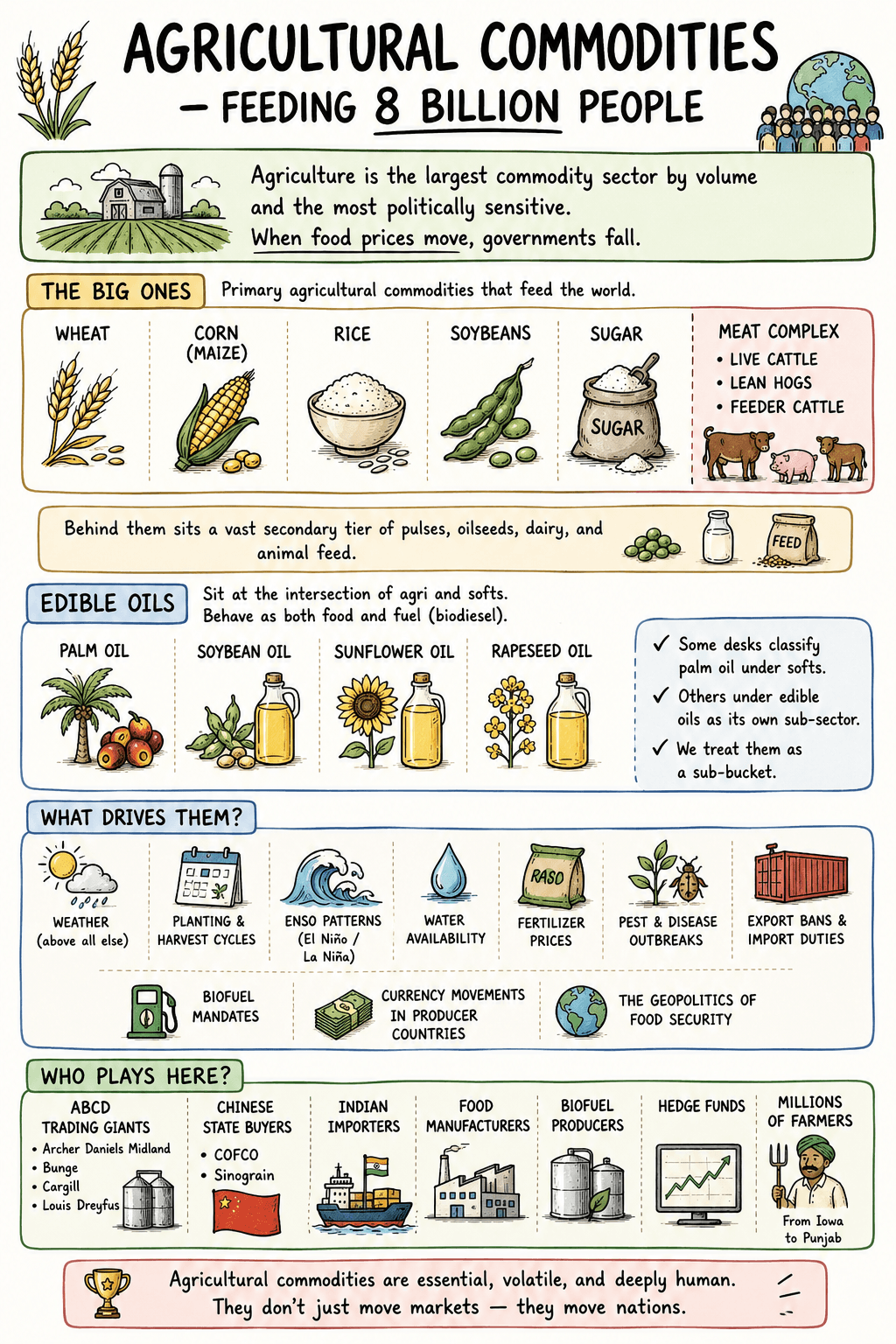
Agriculture is the largest commodity sector by volume and the most politically sensitive. When food prices move, governments fall.
The big ones are wheat, corn (maize), rice, soybeans, sugar (sometimes grouped here, sometimes in softs), and the meat complex (live cattle, lean hogs, feeder cattle). Behind them sits a vast secondary tier of pulses, oilseeds, dairy, and animal feed.
Edible oils — palm oil, soybean oil, sunflower oil, rapeseed oil — sit at the intersection of agri and softs. Some desks classify palm oil under softs; others under edible oils as their own sub-sector. We'll treat them as a sub-bucket because they behave as both food and fuel (biodiesel).
What drives them: Weather (above all else), planting and harvest cycles, ENSO patterns (El Niño / La Niña), water availability, fertilizer prices, pest and disease outbreaks, export bans and import duties, biofuel mandates, currency movements in producer countries, and the geopolitics of food security.
Latest reality check: Wheat and corn prices have been pressured by Iran-war-related fertilizer shortages. Brazil — which accounts for roughly half to 60% of global soybean exports depending on the season — depends heavily on imported fertilizer, a significant share of which transits the Strait of Hormuz. A sustained fertilizer squeeze could compress yields globally in the 2026–27 crop year. Meanwhile, India's basmati rice exports to the Gulf were paused not by drought but by marine insurers refusing to cover war-zone cargo.
Who plays here: The "ABCD" trading giants (Archer Daniels Midland, Bunge, Cargill, Louis Dreyfus), Chinese state buyers (COFCO, Sinograin), Indian importers, food manufacturers, biofuel producers, hedge funds, and millions of farmers from Iowa to Punjab.
4. Soft Commodities — The Volatile Tropics
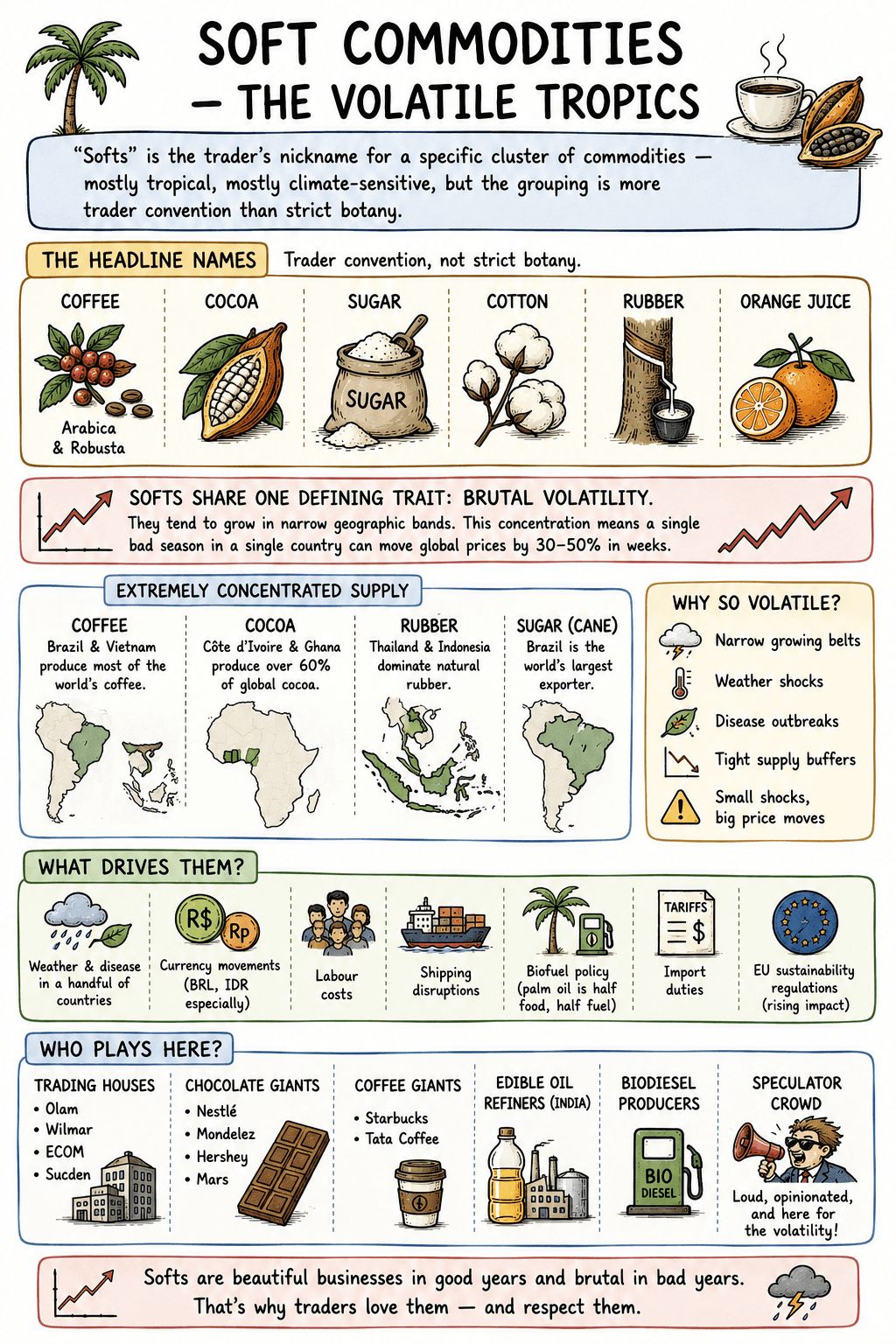
"Softs" is the trader's nickname for a specific cluster of commodities — mostly tropical, mostly climate-sensitive, but the grouping is more trader convention than strict botany. The headline names are coffee (Arabica and Robusta), cocoa, sugar, cotton, rubber, and orange juice. Cotton and orange juice aren't tropical in the strict sense but get grouped here by trading desk convention.
Softs share one defining trait: brutal volatility. They tend to grow in narrow geographic bands. Brazil and Vietnam produce most of the world's coffee. Côte d'Ivoire and Ghana produce over 60% of cocoa. Thailand and Indonesia dominate natural rubber. This concentration means a single bad season in a single country can move global prices by 30–50% in weeks.
What drives them: Weather and disease in a handful of countries, currency movements (especially the Brazilian real and Indonesian rupiah), labour costs, shipping disruptions, biofuel policy (palm oil is half food, half fuel), import duties, and increasingly EU sustainability regulations.
Latest reality check: Cocoa hit an astonishing $12,646 per ton in December 2024 after consecutive bad West African harvests — a near-tripling in eighteen months that broke chocolate industry margins worldwide. Prices have since corrected to around $5,400–6,000 per ton on improved 2025–26 weather, but inventories remain thin. Coffee saw a similar boom in 2024–25 as Brazilian Arabica suffered drought and frost. Palm oil — sitting in the edible oils sub-sector — moves on weather in Sumatra, Indonesian export levies, Indian import duties, and biodiesel mandates.
Who plays here: Trading houses (Olam, Wilmar, ECOM, Sucden), chocolate and coffee giants (Nestlé, Mondelez, Hershey, Mars, Starbucks, Tata Coffee), Indian edible oil refiners, biodiesel producers, and a loud, opinionated speculator crowd that loves softs precisely because they're volatile.
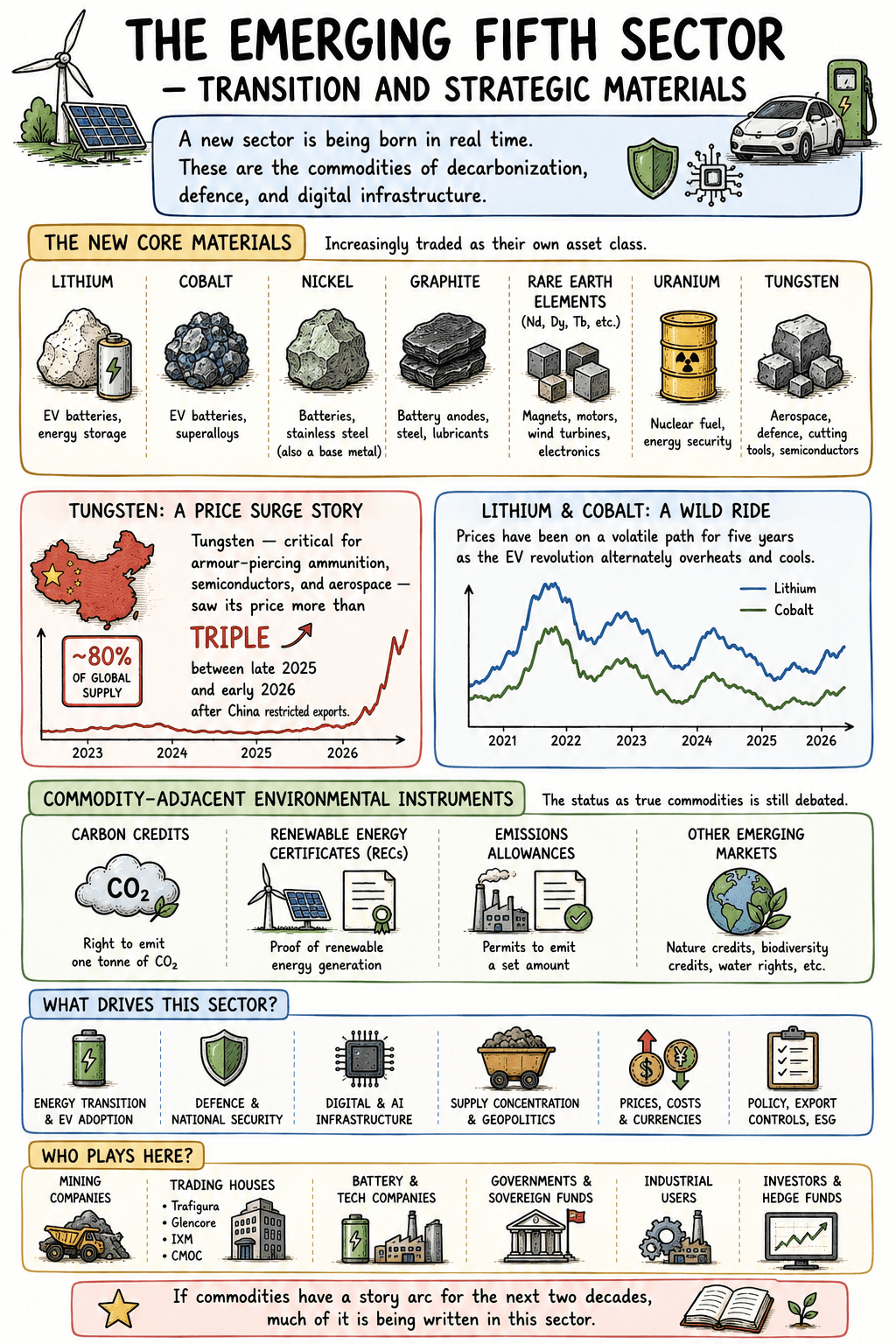
The Emerging Fifth Sector — Transition and Strategic Materials
A new sector is being born in real time. Lithium, cobalt, nickel (yes, also a base metal — the categories are leaky), graphite, rare earth elements (neodymium, dysprosium, terbium), uranium, and tungsten are increasingly traded as their own asset class.
These are the commodities of decarbonization, defence, and digital infrastructure. Tungsten — critical for armour-piercing ammunition, semiconductors, and aerospace — saw its price more than triple between late 2025 and early 2026 after China, which produces roughly 80% of global supply, restricted exports. Lithium and cobalt prices have been on a wild ride for five years as the EV revolution alternately overheats and cools.
Sitting alongside this group are commodity-adjacent traded environmental instruments — carbon credits, renewable energy certificates, emissions allowances — whose status as true commodities is still debated.
If commodities have a story arc for the next two decades, much of it is being written in this sector.
How the Four Families Talk to Each Other
Sectors look separate on a screen. In the real economy, they are deeply linked. Three connections matter most:
- Energy feeds everything. Higher oil and gas prices raise the cost of fertilizer (which raises grain prices), the cost of mining (which raises metals prices), the cost of refining (which raises palm oil prices), and the cost of shipping (which raises everything).
- The US dollar is the silent third party. Most commodities are priced in dollars. A stronger dollar makes commodities more expensive for everyone else and tends to push prices down. A weaker dollar does the opposite. Gold is the classic dollar mirror.
- China is the demand engine. China consumes roughly half the world's copper, aluminium, coal, iron ore, and soybeans. When Chinese factories slow or speed up, the entire commodity complex feels it within weeks.
The India Lens
India sits at the receiving end of three of the four sectors:
- Energy: The large majority of crude oil is imported (typically 85–88%), along with a significant share of natural gas, much of it via Hormuz.
- Metals: India is a significant importer of copper concentrate, a major gold consumer, and a growing player in steel and aluminium production.
- Agri: India is largely self-sufficient in grains but vulnerable to pulses, edible oil, and fertilizer imports.
- Softs: India is one of the world's largest importers of palm oil and a major buyer of rubber and cocoa. We are also a producer of tea, coffee, sugar, cotton, and spices — so we sit on both sides of the table.
For Indian businesses, "knowing your commodity sector" is not optional. A paint company is a metals story (titanium dioxide, zinc). A biscuit company is a softs and edible oils story (palm oil, sugar, cocoa). An airline is pure energy. A jeweller is pure precious metals. A fertilizer company is a natural gas story wearing an agriculture mask.
Why Sector Literacy Is the Real Skill
Most people read commodity news as a single stream — "oil up, gold up, copper down." That is the headline reader's view. The trader's view is structural: each sector has its own clock, its own weather, its own politics. A copper trader doesn't care about a Brazilian frost. A coffee trader doesn't care about a Chilean mine strike. But both care, indirectly, about the US dollar and Chinese growth.
Learn the families. Learn what drives each one. Learn how they connect. That is the foundation everything else in this masterclass is built on.