How Commodity Markets Actually Work
Most people think of commodity trading as buying and selling physical goods. The reality is more layered — futures contracts, paper markets, and physical delivery interact in ways that shape every price you see.
Once you understand how the plumbing works, the headlines stop being chaos and start being signals.
The Two Markets Hidden Inside Every Commodity
Every commodity has two parallel markets running at the same time. The physical market is where actual barrels, bags, tonnes, and tankers move from one place to another. The paper market is the financial layer on top, where contracts representing those barrels, bags, and tonnes are traded by people who often have no intention of touching the underlying goods.
Both markets are connected by a single thread: the benchmark price. A refiner buying a physical cargo of crude pays the front-month benchmark futures price plus or minus a differential for grade, delivery, and timing. A speculator in Singapore betting on Brent doesn't take delivery of anything — but collective order flow from hedgers, speculators, market makers, and arbitrageurs is what determines the front-month futures price.
This is why the market reacts to a tweet before any cargo has moved. The paper market is faster, larger, and more sensitive than the physical market — and physical buyers are forced to follow it.
The Three Roles Around Every Commodity Table
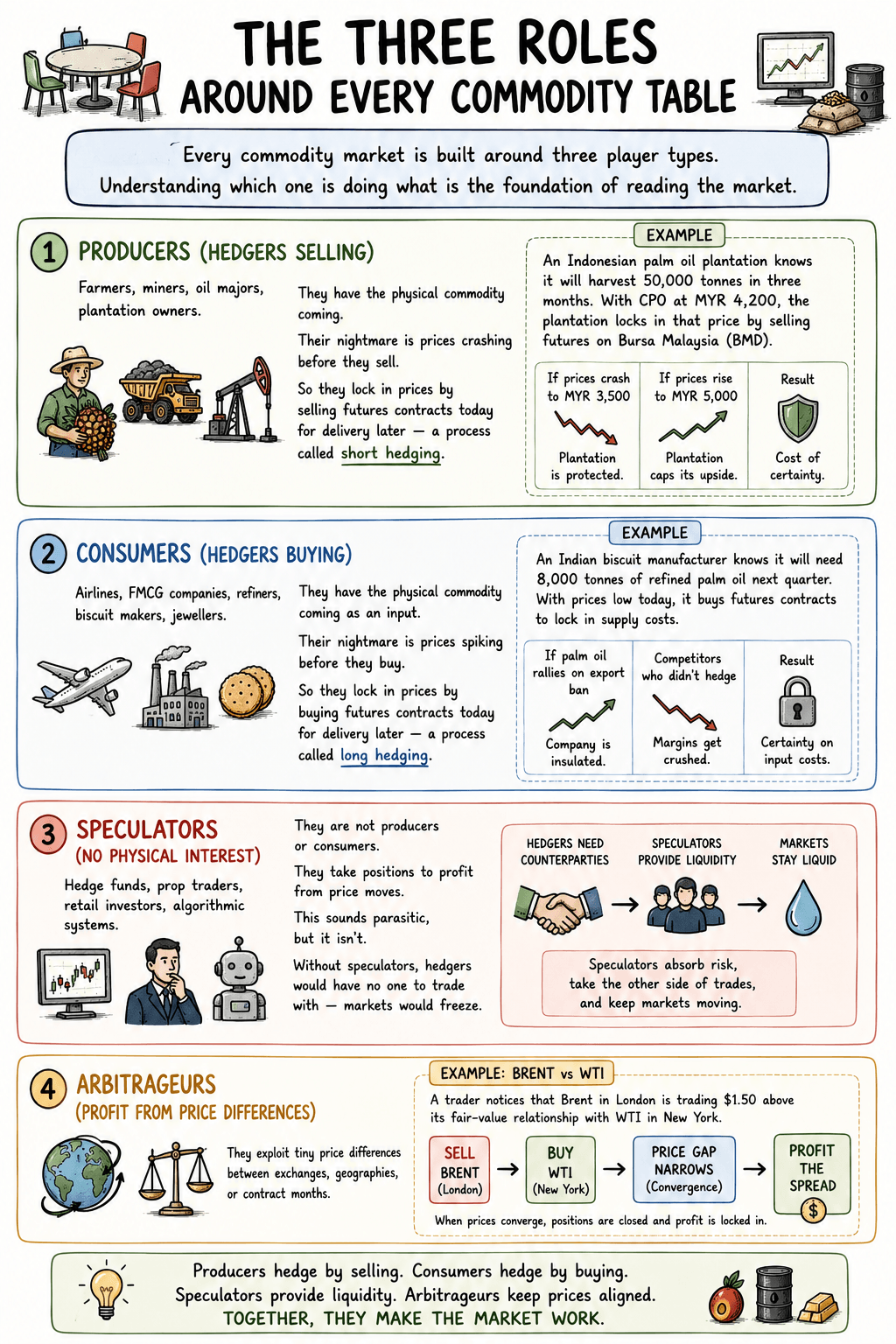
Every commodity market is built around three player types. Understanding which one is doing what is the foundation of reading the market.
1. Producers (hedgers selling): Farmers, miners, oil majors, plantation owners. They have the physical commodity coming. Their nightmare is prices crashing before they sell. So they lock in prices by selling futures contracts today for delivery later — a process called short hedging.
Example: An Indonesian palm oil plantation knows it will harvest 50,000 tonnes in three months. With CPO at MYR 4,200, the plantation locks in that price by selling futures on Bursa Malaysia (BMD). If prices crash to MYR 3,500 by harvest, the plantation is protected. If prices rise to MYR 5,000, the plantation has capped its upside — but that was the cost of certainty.
2. Consumers (hedgers buying): Airlines, FMCG companies, refiners, biscuit makers, jewellers. They have the physical commodity coming as an input. Their nightmare is prices spiking before they buy. So they lock in prices by buying futures contracts today for delivery later — long hedging.
Example: An Indian biscuit manufacturer knows it will need 8,000 tonnes of refined palm oil next quarter. With prices low today, it buys futures contracts to lock in supply costs. If palm oil rallies on an Indonesian export ban, the company is insulated. Its competitors who didn't hedge will see margins crushed.
3. Speculators (no physical interest): Hedge funds, prop traders, retail investors, algorithmic systems. They are not producers or consumers. They take positions to profit from price moves. This sounds parasitic, but it isn't. Without speculators, hedgers would have no one to trade with — markets would freeze.
A fourth, less-discussed role is the arbitrageur, who profits by exploiting tiny price differences between exchanges, geographies, or contract months. A trader noticing that Brent in London is trading $1.50 above its fair-value relationship with WTI in New York will sell one and buy the other, pocketing the convergence.
Where Commodities Actually Trade
There is no single "commodity market." There are roughly fifteen major exchanges around the world, each with its own dominant contracts. The top ones every operator should know:
- CME Group (Chicago) — the largest derivatives marketplace on earth. Houses NYMEX (energy: WTI crude, natural gas, gasoline, heating oil), COMEX (metals: gold, silver, copper), and CBOT (grains and oilseeds: corn, soybeans, wheat). Also lists newer contracts like lithium carbonate futures, which have seen record volumes in 2026.
- Intercontinental Exchange (ICE) — headquartered in Atlanta, with major futures venues including ICE Futures Europe in London (Brent crude, Robusta coffee, sugar, European natural gas (TTF), carbon emissions) and ICE Futures U.S. in New York (Arabica coffee, cocoa, cotton, orange juice). If you trade softs or European energy, ICE is the room.
- LME (London Metal Exchange) — the world's primary venue for industrial base metals. Copper, aluminium, zinc, nickel, lead, tin. Unique in offering physically deliverable contracts and using daily prompt dates in the near term rather than the standard monthly futures structure — a quirk built for industrial users who need precise hedging dates.
- BMD (Bursa Malaysia Derivatives) — the global price-setter for crude palm oil. If you care about CPO, you watch BMD.
- SHFE (Shanghai Futures Exchange) and DCE (Dalian Commodity Exchange) — China's domestic powerhouses. Copper, aluminium, steel rebar, iron ore, soybean meal, palm oil. Increasingly important because China consumes such a large share of global commodities.
- MCX (Multi Commodity Exchange of India) — India's primary commodity exchange. Energy (crude, natural gas), bullion (gold, silver), base metals (copper, zinc, aluminium, lead). Indian crude and bullion contracts here often serve as a hedging tool for domestic players who prefer INR-denominated hedging or face restrictions on accessing offshore exchanges.
- NCDEX (India) — agri-focused: guar, chana, jeera, turmeric, castor seed. Where Indian agricultural price discovery happens.
- SGX (Singapore) — the Asian hub for iron ore, rubber, and increasingly LNG. SGX iron ore derivatives are a major global benchmark for financial hedging, used alongside Platts physical assessments.
- DME (Dubai) — DME Oman is the exchange-traded benchmark widely used for Middle East crude pricing into Asia, sitting alongside the broader Dubai/Oman price complex.
Each exchange sets the global benchmark for its dominant contract. The Brent price you see on Bloomberg is the front-month ICE Brent future. The gold price is built from two parallel benchmarks: COMEX futures dominate futures price discovery, while the LBMA London Gold Price fix anchors the OTC spot market. Copper is LME 3-month copper. Palm oil is BMD third-month CPO. Knowing which exchange owns which benchmark is half of commodity literacy.
The Anatomy of a Futures Contract
Every futures contract is built on five components:
- The underlying — what you're actually trading. WTI light sweet crude, LME Grade A copper, ICE Robusta coffee.
- Contract size — the standard quantity per contract. One Brent contract is 1,000 barrels. One COMEX gold contract is 100 troy ounces. One CBOT corn contract is 5,000 bushels.
- Delivery month — when the contract settles. Crude oil trades dozens of contract months out, but most volume is concentrated in the front month and the next two or three.
- Delivery location and method — where physical delivery would happen if the contract goes to settlement. Cushing, Oklahoma for WTI. Rotterdam or Singapore for various refined products. Or cash settlement, where no physical delivery occurs and the contract settles in money based on a price index.
- Tick size and value — the minimum price movement and what it translates to in dollars. A one-cent move in CME corn futures = $50 per contract.
Most futures contracts never go to physical delivery. They are closed out before expiry by taking the opposite position. The producer who sold futures three months ago buys them back the day before expiry. The speculator who was long unwinds the position. A small minority of futures contracts go to physical delivery — the exact share varies dramatically by commodity and exchange — yet that minority is what keeps the paper price honest. The threat of delivery is what tethers futures to reality.
Spot, Forwards, Futures, Swaps, and Options — The Full Toolbox
Beyond futures, the modern commodity market uses an entire toolbox of contracts:
- Spot — buy now, deliver now (or within a few days). The price a refinery actually pays for a tanker arriving this week.
- Forwards — bilateral, customized "I'll sell you X tonnes at Y price on Z date." Used heavily between producers and large consumers, off-exchange. Most physical trade happens via forwards.
- Futures — standardized, exchange-traded forwards. Liquid, transparent, anonymous.
- Swaps — financial contracts where two parties exchange cash flows tied to different price references. An airline might swap fixed jet fuel prices for floating prices, or vice versa.
- Options — the right, but not the obligation, to buy (a "call") or sell (a "put") at a fixed price. Costs an upfront premium. Used to cap downside or upside without locking in a single price.
Sophisticated commodity programs combine these instruments. A copper miner might sell forwards for 60% of production, use futures for shorter-term tactical hedging, and buy put options to protect a price floor on the unhedged portion.

The Players Behind the Players
Commodities don't trade themselves. Three structural groups make the markets function:
Trading houses are the giants you've heard less about than you should have. Vitol, Glencore, Trafigura, Mercuria, Gunvor in oil and metals. Cargill, ADM, Bunge, Louis Dreyfus, COFCO, Olam, Wilmar in agri and softs. These firms buy from producers, store, ship, blend, and sell to end users. They are the physical market. Vitol alone trades volumes of oil and refined products exceeding the daily consumption of many countries.
Brokers and clearing houses are the intermediaries. Brokers connect buyers and sellers. Clearing houses (LCH, CME Clearing, ICE Clear) sit in the middle of every futures trade, guaranteeing performance — if one side defaults, the clearing house steps in. This is why nobody worries about counterparty risk on a futures exchange the way they do in OTC deals.
Financial participants — investment banks (Goldman, JPMorgan, Morgan Stanley), commodity-focused hedge funds, pension funds with commodity allocations, ETF providers (the SPDR Gold Trust, USO oil ETF), and increasingly algorithmic traders. They provide liquidity, take views, and have come to dominate paper market volume.
How a Trade Actually Moves the Market
Imagine a hedge fund decides at 9:32 AM London time that copper is going higher. It buys 500 lots of LME 3-month copper. Five things happen in sequence — most within seconds:
- The buy order hits the LME's electronic order book, lifting the offer price.
- Other algorithms detect the volume surge and follow, amplifying the move.
- The new price feeds into Bloomberg, Reuters, and trading screens worldwide.
- Physical traders adjust their offers to refiners and fabricators based on the new benchmark.
- By the end of the day, a copper wire manufacturer in Mumbai is paying a slightly higher price for tomorrow's order — without ever knowing why.
This is the lived reality of commodity markets. A decision taken in a Mayfair office at 9:32 AM rewrites the input cost of a factory in Maharashtra by 4:00 PM IST. The chain runs through five intermediaries and three time zones, but it runs every single trading day.
The India Lens
India's commodity market structure has three peculiarities worth knowing:
- Domestic vs. global price gap. Indian commodity prices often diverge from international ones because of import duties, GST, freight, and the rupee. MCX gold can trade at a meaningful premium or discount to COMEX. This gap itself is a tradable signal.
- Regulatory restrictions. SEBI (which absorbed FMC in 2015) regulates Indian commodity exchanges. Trading in certain agri commodities has been periodically suspended in recent years to control food inflation — most famously in chana, mustard seed, soybean, and wheat. Operators need to track these policy moves as carefully as price moves.
- The hedge gap. Most Indian companies dramatically under-hedge their commodity exposure compared to global peers. Many F&B and FMCG firms still treat commodity volatility as "market noise" rather than a manageable risk. This is changing fast — the firms building real procurement intelligence teams are the ones quietly winning on margin.
Mini Case Study: The Two Biscuit Companies
Two mid-sized Indian biscuit manufacturers, similar size, similar product lines. Both depend heavily on palm oil, sugar, and wheat. In late 2024, palm oil started a steady climb that lasted through 2025.
Company A hedged. Its procurement head, watching BMD futures and Indonesian export levy signals, locked in 60% of expected palm oil consumption for 2025 through a mix of forward contracts with refiners and futures positions. Average effective cost: roughly 12% below the eventual 2025 average.
Company B did not hedge. Its procurement was managed on a spot basis — "we'll buy what we need, when we need it." When palm oil rallied, Company B's input costs jumped quarter after quarter. By mid-2025, Company B was running at half the gross margin of Company A on the same SKUs.
Same business. Same products. Same suppliers. The only difference was whether the procurement team treated the commodity market as a system to be navigated, or a force of nature to be endured.
What Reading the Market Actually Means
Reading commodity markets is not about predicting prices. No one — not Goldman, not Vitol, not the smartest hedge fund — predicts commodity prices consistently with high accuracy. Reading the market means:
- Knowing which exchange owns the benchmark for each commodity you care about.
- Knowing the size and structure of positions (the CFTC's Commitment of Traders report is gold here).
- Knowing whether the curve is in contango (futures higher than spot, signalling oversupply or carry trade) or backwardation (futures lower than spot, signalling tight physical market).
- Knowing the difference between a paper-driven move (speculator positioning) and a physical-driven move (real inventory or supply change).
- Knowing which currencies, freight rates, and policies sit upstream of your commodity.
Get those five things right, and you stop being a headline reader. You become someone who can act with conviction while everyone else is still trying to figure out what just happened.