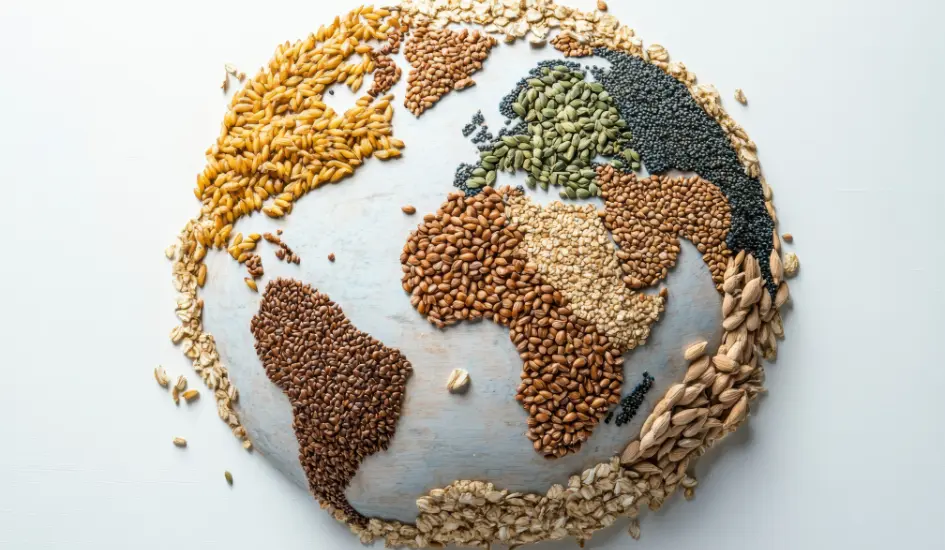
3. Surprising Facts About Commodities
🍌 Bananas
🍌 Bananas are the most exported fruit in the world. Over 20 million tons are traded annually, mostly from countries like 🇪🇨 Ecuador, 🇨🇴 Colombia, 🇵🇭 the Philippines, and 🇨🇷 Costa Rica.
🍌 Bananas have their own commodity index. The World Bank tracks international banana prices due to their impact on food inflation and trade balances in major producing nations.
🍌 Bananas are grown in more than 130 countries and are one of the most globally distributed crops.
🍌 Almost all commercial bananas are clones. The global supply depends heavily on the Cavendish variety, which is vulnerable to disease outbreaks like Panama Disease (TR4), a major threat to global banana supply chains.
🍌 Banana shipping helped invent refrigerated transport. The "banana boats" of the early 1900s pioneered cooling tech to keep the fruit fresh during long voyages, changing the global food supply chain forever.
🍌 Banana prices have sparked political unrest. In countries like Egypt, and Ecuador, sudden price spikes have led to public protests, import bans, and anti-hoarding crackdowns.
🍌 Bananas are price-controlled in many economies. Because they're a staple food for millions, some governments impose price ceilings or subsidies to avoid social tension.
🍌 Bananas are picked green and ripened using ethylene gas. This controlled process ensures they reach consumers at peak yellow, whether you’re in Nairobi or New York.
🍌 Bananas are technically berries. In botanical terms, bananas meet all the criteria of a berry, while strawberries and raspberries do not.
🍫 Cocoa
🍫 Cocoa is the primary ingredient in chocolate and one of the most volatile soft commodities, driven by weather, disease, and political instability in producing nations.
🍫 Around 60% of the world’s cocoa comes from just two countries: 🇨🇮 Côte d’Ivoire and 🇬🇭 Ghana. Any disruption in either can send global prices soaring.
🍫 In 2024, cocoa prices hit multi-decade highs due to El Niño, crop disease, and poor yields fueling concerns over supply security and pushing up consumer chocolate prices worldwide.
🍫 The cocoa trade is still deeply affected by structural issues like child labor, aging trees, and lack of access to fertilizers making it a commodity with long-term supply risks.
🍫 Cocoa futures trade primarily on ICE (Intercontinental Exchange), with contracts in both New York and London serving as global benchmarks.
🍫 The London cocoa market is denominated in pounds and includes quality premiums for beans from specific origins, making it distinct from the dollar-based New York contract.
🍫 Political risk looms large in Cocoa. In 2022, Ghana and Côte d’Ivoire threatened to suspend sales to force buyers to pay a living income differential, shaking up the cocoa value chain.
🍫 Speculative Cocoa positioning by hedge funds and commodity traders often exaggerates price swings, especially during tight supply cycles or macro risk events.
🍫 Chocolate demand remains steady even during recessions, making cocoa somewhat recession-resistant. But high prices can shift demand toward lower-quality alternatives.
🍫 With increasing ESG scrutiny, large chocolate companies face pressure to prove ethical sourcing, adding a new layer of complexity to the cocoa commodity trade.
🍫 The price of chocolate can be affected more by African politics than by consumer demand. Côte d’Ivoire and Ghana together control over 60% of the world’s cocoa supply.
☕️ Coffee
☕️ The two main coffee types, Arabica and Robusta, have separate futures contracts, price dynamics, and growing regions. Arabica trades on ICE, Robusta on LIFFE.
☕️ Brazil and Vietnam dominate global coffee supply. A frost in Brazil or flooding in Vietnam can send prices soaring overnight.
☕️ Coffee futures are highly weather-sensitive. Drought, frost, or delayed rains in the "coffee belt" regularly cause major volatility.
☕️ Coffee is one of the most speculated agri-futures, with hedge funds and commodity traders piling in during periods of volatility often triggering exaggerated price moves.
☕️ The coffee market is exposed to labor and political risk, especially in Central America and Africa, where worker protests, land rights, or instability can disrupt supply chains.
☕️ Most retail coffee chains buy via long-term contracts, but spot and futures markets still set the baseline for wholesale pricing and farm income.
☕️ Coffee demand is inelastic but not recession-proof. During downturns, premium coffee demand can dip as consumers shift to cheaper brands or brew at home.
☕️ Coffee, one of the most traded soft commodities, has also toppled governments. In Haiti (1790s) and Brazil (1930s), coffee-related trade disputes and economic crashes sparked revolts.
☕️ Over 2 billion cups are consumed every day, and its price is so important that it's monitored by several governments to track inflation in developing economies.
⚡️ Copper
⚡️ Copper is one of the most economically sensitive commodities, often called "Dr. Copper" because of its ability to signal turning points in the global economy.
⚡️ Used in everything from construction and power grids to electronics and electric vehicles, copper demand is tightly linked to global infrastructure and industrial cycles.
⚡️ The top copper producers are 🇨🇱 Chile, 🇵🇪 Peru, 🇨🇳 China, and 🇺🇸 the US. Chile alone accounts for about 25% of global mined supply.
⚡️ China is both the largest importer and consumer of copper, meaning shifts in Chinese housing, manufacturing, or stimulus policies can instantly move global prices.
⚡️ As the world electrifies, copper demand is expected to surge especially for EVs, which use 2–4 times more copper than internal combustion cars, and for renewable energy systems like solar and wind.
⚡️ Copper futures trade heavily on the COMEX and LME, with LME warehouse stockpiles often watched for clues about global demand and supply tightness.
⚡️ Copper supply is vulnerable to labor strikes, protests, and environmental restrictions, especially in 🇵🇪 Peru and 🇨🇱 Chile, where mines are often located in high-altitude, socially tense regions.
⚡️ Copper is increasingly being hoarded by governments and institutions as a strategic resource viewed as essential to national security and the energy transition.
⚡️ Scrap copper recycling now accounts for roughly 30% of global supply, making secondary markets and metal flows critical to pricing and availability.
⚡️ In 2023–2025, copper prices spiked due to tight inventories, rising green demand, and underinvestment in new mining capacity raising concerns of a coming copper deficit.
⚡️ There’s 5x more copper in an electric vehicle than in a gas-powered car. This makes copper a stealth play on EV adoption and a geopolitical flashpoint for resource-hungry economies.
⛽️ Crude oil
⛽️ Crude oil is the most traded physical commodity on Earth, moving over 100 million barrels per day globally across spot, futures, and OTC markets.
⛽️ In April 2020, US crude oil futures (WTI) crashed to -$37.63 per barrel. Yes, negative. Traders were paying others to take oil off their hands because there was no storage left. It's the only time in history a major commodity was worth less than zero.
⛽️ OPEC+ decisions can move global markets within minutes. A single production cut announcement has been known to swing oil prices by 5–10% in a day.
⛽️ Brent and WTI are not the same. Brent (North Sea) is the global benchmark; WTI (West Texas) is US-focused. Traders arbitrage between them using the Brent–WTI spread.
⛽️ Oil isn't just for fuel. It’s the feedstock for plastics, fertilizers, synthetic fabrics, cosmetics, and pharmaceuticals.
⛽️ Geopolitics and oil are inseparable. Wars in the Middle East, sanctions on Iran or Russia, or tanker blockades in the Strait of Hormuz can cause massive market spikes.
⛽️ Oil has one of the deepest and most liquid derivatives markets, with futures, options, swaps, and ETFs traded by institutions, speculators, and hedgers alike.
⛽️ Strategic Petroleum Reserves (SPRs) are held by countries like the US and China as a buffer against price shocks
⛽️ The oil market is increasingly shaped by algo trading and high-frequency strategies, making it both volatile and prone to exaggerated intraday moves.
⛽️ "Petrodollar recycling" is real. Oil-exporting nations reinvest surplus revenue in global capital markets linking crude prices to bond yields and equity flows.
⛽️ The US Strategic Petroleum Reserve (SPR) is the world's largest supply of emergency crude oil. It holds hundreds of millions of barrels, stored in underground salt caverns in Texas and Louisiana, in case of national supply shocks.
⛽️ One large oil tanker carries over 2 million barrels of crude and takes weeks to deliver. A delay in the Suez Canal can impact global oil prices in hours.
🥚 Eggs
🥚 Eggs are one of the most price-volatile food staples. In several countries, they’ve outpaced inflation rates faster than grains or fuel.
🥚 Global egg prices spiked dramatically during 2022–2023 due to avian flu outbreaks, which wiped out tens of millions of laying hens especially in the US and EU.
🥚 Eggs are among the few animal proteins consumed daily in both rich and low-income economies, making them a critical soft commodity across income classes.
💡 In 2023, egg smuggling became a real thing. After US prices doubled, cartons were being smuggled across the Mexican border due to price arbitrage.
🥚 Egg prices are tightly linked to input costs (soy, corn), energy, and disease outbreaks. This makes them a high-beta asset in the food commodity chain.
🐟 Fish
🐟 Fish is the most traded animal protein in the world, with over 35% of global production entering international markets. That's more than beef, poultry, or pork.
🐟 The top exporters include 🇨🇳 China, 🇳🇴 Norway, 🇻🇳 Vietnam, and 🇨🇱 Chile, with species like salmon, tuna, shrimp, and tilapia dominating global trade.
🐟 Wild fish stocks are finite and declining, so nearly 50% of the global fish supply now comes from aquaculture. It's a sector growing faster than any other food commodity.
🐟 Norway’s salmon exports are so economically significant that salmon spot prices are tracked like a commodity index and influence the Norwegian krone (NOK).
🐟 Global fish prices are driven by climate change, ocean temperatures, overfishing regulations, fuel costs, and disease outbreaks making it a highly complex soft commodity.
🐟 Major fish futures contracts remain rare, but regional spot markets (especially for salmon in 🇳🇴 Norway and shrimp in 🇮🇳 India) act as pricing benchmarks for international buyers.
🐟 Illegal, unreported, and unregulated (IUU) fishing distorts supply and pricing. It's estimated to account for up to 30% of global wild-caught fish, making it a hidden volatility factor.
🐟 Trade disputes over fishing rights such as between 🇪🇺 EU and 🇬🇧 UK have triggered tariffs, export bans, and regulatory chaos, turning fish into a geopolitical flashpoint.
🐟 Fishmeal and fish oil, derived from low-grade catch, are critical inputs in livestock and aquaculture feed. Their prices are linked to broader agri-commodity cycles like soy and corn.
🏅 Gold
🏅 Despite all the talk of fiat currency and digital assets, central banks hold over 35,000 tonnes of gold. Why? Because in times of crisis, gold is still the go-to asset.
🥇 Gold is the most widely held reserve asset in the world, sitting on the balance sheets of nearly every central bank.
🥇 Unlike most commodities, gold is not consumed. Nearly all the gold ever mined still exists, mostly in the form of jewelry, bars, coins, and vault reserves.
🥇 Gold prices tend to rise during periods of inflation, currency devaluation, and geopolitical instability, earning it the title "safe-haven asset".
🥇 In 2022–2023, central banks set records for net gold purchases, led by 🇨🇳 China, 🇹🇷 Turkey, and 🇮🇳 India, reflecting a global trend to diversify away from US dollar reserves.
🥇 Gold futures are among the most actively traded contracts in the world, with deep liquidity on major exchanges.
🥇 Gold has outperformed many major stock indexes during periods of financial crisis, including 2008 and 2020, and is increasingly included in portfolio diversification models.
🥇 Gold is also a key industrial input, used in electronics, semiconductors, and aerospace though industrial demand is only a small fraction of total gold use.
🥇 China is both the world's largest gold producer and the largest consumer, with strong cultural and investment demand especially around Lunar New Year and wedding seasons.
🥇 Physical gold premiums can diverge significantly from spot prices in times of market stress, due to supply-chain issues, mint shortages, or surging retail demand.
🔋 Lithium
🔋 Lithium is everywhere in the earth’s crust. The problem? It's expensive, slow, and environmentally messy to extract and refine. That's why China, which controls much of the world’s lithium processing capacity, has massive leverage over global battery supply chains.
🔋 Lithium is the core input in most rechargeable batteries, making it essential for electric vehicles, smartphones, laptops, and large-scale energy storage.
🔋 Demand for lithium has exploded due to the EV boom, with global consumption more than tripling since 2015 and projected to keep climbing through 2030.
🔋 The lithium supply chain is highly concentrated. 🇦🇺 Australia dominates mining, while 🇨🇱 Chile and 🇦🇷 Argentina extract it from salt flats. 🇨🇳 China controls nearly 60% of global refining capacity.
🔋 Lithium prices are notoriously volatile. Lithium carbonate prices surged over 1,000% between 2020 and 2022, then crashed in 2023 due to oversupply fears and weak EV sales.
🔋 Lithium isn't traded on traditional commodity exchanges. Instead, it moves through long-term contracts and spot deals with opaque pricing, though benchmark pricing services like Fastmarkets and Asian Metal are gaining influence.
🔋 Unlike oil or copper, lithium requires chemical processing before it's useful. Battery-grade lithium hydroxide and carbonate are far more valuable than raw spodumene ore.
🔋 Lithium nationalism is rising. 🇲🇽 Mexico nationalized its lithium reserves in 2022, and 🇧🇴 Bolivia, sitting on massive reserves, seeks state control over extraction and refining.
🔋 Lithium's strategic importance is rising fast. Many analysts now view it as the new oil of the 21st century, crucial to both economic power and energy security.
🥛 Milk
🥛 Milk is one of the most heavily subsidized and politically sensitive commodities, especially in countries like 🇺🇸 US, 🇪🇺 EU members, 🇮🇳 India, and 🇳🇿 New Zealand.
🥛 Global dairy trade is dominated by just a few exporters, with 🇳🇿 New Zealand accounting for over 30% of all international milk powder exports.
🥛 Unlike many soft commodities, milk is rarely traded in raw form across borders. Instead, it’s exported as derivatives like milk powder, cheese, butter, and whey.
🥛 The Global Dairy Trade (GDT) auction, based in 🇳🇿 New Zealand, acts as a global price benchmark for milk powder and other processed dairy products.
🥛 Dairy prices are highly sensitive to feed costs, which are tied to corn and soybean prices. Droughts in grain regions can ripple into milk inflation globally.
🥛 Milk futures are traded on exchanges like the CME, but volume is limited compared to grains or energy, and contracts often focus on Class III and IV milk used for cheese and butter.
🥛 In 🇮🇳 India, the world's largest milk producer, dairy inflation directly affects food security, making milk a priority item for price controls and subsidy programs.
🥛 Climate change is pressuring the dairy industry, with rising temperatures affecting cow productivity and water-intensive feed crops like alfalfa becoming harder to sustain.
🥛 In 🇨🇳 China, growing demand for dairy products is reshaping global trade flows, driving investment in overseas dairy farms and long-term supply contracts.
🥛 Milk’s perishability and cold-chain requirements make logistics a critical bottleneck, especially in emerging markets without reliable refrigeration infrastructure.
🧅 Onions
🧅 India has banned onion futures multiple times due to price spikes that triggered public outrage. Onions are a politically sensitive food staple in India, and inflation in onion prices has contributed to protests and even helped topple governments.
🧅 Onions are one of the most price-sensitive vegetables globally and a major driver of food inflation in countries like 🇮🇳 India, 🇧🇩 Bangladesh, and 🇵🇰 Pakistan.
🧅 India, the world's second-largest onion producer, has repeatedly banned onion exports to control domestic prices affecting millions of traders and entire regional markets.
🧅 In 1958, the 🧅 US government banned onion futures trading on the Chicago Mercantile Exchange after market manipulation caused extreme volatility. It remains the only commodity permanently banned from US futures markets.
🧅 Unlike grains or oilseeds, onions are difficult to store long-term. Lack of cold storage leads to seasonal gluts and shortages, amplifying volatility in spot markets.
🧅 Onion smuggling is real. Export bans often result in illegal cross-border trade, especially between 🇮🇳 India and 🇧🇩 Bangladesh, driving black-market pricing.
🧅 Governments use minimum export prices, buffer stock purchases, and subsidies to manage onion supply, making the market highly distorted and policy-driven.
🧅 Onions lack global futures markets, but local spot markets like Lasalgaon in 🇮🇳 India function as price benchmarks for domestic and regional trade.
🧅 Because they're a dietary staple, onion prices are closely monitored by central banks and statistical agencies in developing economies as an early inflation signal.
🧅 In regions without onion self-sufficiency, even minor crop damage from unseasonal rain or drought can cause nationwide shortages within days.
Rare earth elements
🌍 Rare earth elements are a group of 17 chemically similar metals used in high-tech applications from smartphones and EV motors to wind turbines, military systems, and guided missiles.
🌍 Rare earth elements are not actually rare in the Earth’s crust but they're rarely found in economically viable concentrations and are difficult to extract and refine cleanly.
🇨🇳 China dominates Rare earth elements at every stage - mining, refining, and processing. It controls over 85% of global refining capacity. This makes it a key geopolitical chokepoint.
🌍 In 2010, China restricted rare earth elements exports to 🇯🇵 Japan during a diplomatic dispute. Prices spiked 700% and exposed global reliance on a single country for critical materials.
🌍 Rare earth elements like neodymium and dysprosium are essential for permanent magnets used in EVs, drones, wind turbines, and military tech. Without them, electrification and defense systems stall.
🌍 The US, 🇦🇺 Australia, 🇨🇦 Canada, and 🇸🇪 Sweden are ramping up exploration and investment in rare earth elements to build non-Chinese supply chains. But progress is slow due to environmental and permitting challenges.
🌍 Most rare earth elements mining produces radioactive waste as a byproduct making it politically sensitive, expensive to manage, and prone to ESG scrutiny.
🌍 Rare earth elements spot markets are thin and opaque, with prices published by specialty providers like Asian Metal and Argus. Futures trading is still limited and mostly OTC.
🌍 The Pentagon has classified rare earth elements as strategic materials, funding domestic processing facilities and stockpiling efforts to ensure national security access.
🍭 Sugar
🍭 Sugar is one of the most widely traded agricultural commodities, with over 180 countries consuming it and more than 120 producing it.
🍭 The global sugar market is dominated by 🇧🇷 Brazil, 🇮🇳 India, 🇹🇭 Thailand, and 🇨🇳 China, making it highly vulnerable to weather and policy shifts.
🍭 Brazil’s sugar output is closely tied to oil prices. When crude rises, more sugarcane is diverted to ethanol production, tightening global sugar supply.
🍭 Sugar prices are regulated or subsidized in many countries, including the US and India, distorting true market signals and often triggering trade disputes.
🍭 India frequently imposes export restrictions or subsidies on sugar, making its domestic surplus or deficit a major swing factor in global prices.
🍭 Weather matters. El Niño and monsoon variability can devastate sugarcane harvests in key producing nations, sending futures surging.
🍭 Sugar futures trade on major exchanges like ICE and MCX, and the market sees significant speculative participation making it prone to sharp short-term moves.
🍭 The white sugar vs. raw sugar spread is closely tracked by traders and refiners to assess processing margins and trade opportunities.
🍭 Sugar is one of the few agri-commodities with direct links to health policy. Rising health taxes and anti-obesity campaigns can influence long-term demand.
🍭 In times of food inflation, sugar is often among the first targets for price caps and anti-hoarding raids especially in Asia and Africa.
🍭 Sugar was once so valuable it was called "white gold" and its trade history is deeply tied to the rise of empires, colonialism, and the Atlantic slave trade.
☢️ Uranium
☢️ Uranium is used primarily as nuclear fuel and powers over 400 nuclear reactors in more than 30 countries worldwide.
☢️ Unlike oil or gold, uranium does not trade on open spot exchanges. Prices are negotiated privately and tracked through indicators like UxC and TradeTech.
☢️ The global uranium market is heavily influenced by geopolitics, including 🇺🇸 US bans on 🇷🇺 Russian supply and unrest in producing countries like 🇳🇪 Niger and 🇰🇿 Kazakhstan.
☢️ Most of the world's uranium comes from just a handful of countries, with 🇰🇿 Kazakhstan, 🇨🇦 Canada, and 🇦🇺 Australia leading global production.
☢️ It takes 7 to 10 years to bring a new uranium mine online, which limits the market's ability to respond quickly to supply shocks or demand surges.
☢️ Demand is expected to rise significantly as countries expand nuclear energy to meet climate goals, with 🇨🇳 China and 🇮🇳 India planning dozens of new reactors.
☢️ Physical uranium is being stockpiled by funds like the Sprott Physical Uranium Trust, removing supply from the open market and creating upward price pressure.
☢️ Unlike fossil fuels, uranium provides baseload power with zero emissions during operation, making it central to many long-term energy transition strategies.
☢️ Spot uranium prices rose more than 200% between 2020 and 2025 due to supply tightening, geopolitical risk, and rising institutional interest.
☢️ Uranium is gaining attention in the DeFi space, with tokenized price exposure and price action tokens emerging on blockchain platforms.
☢️ Uranium can't be casually traded on open exchanges because it's radioactive and heavily regulated. Most uranium trades are done through long-term private contracts, often under government oversight.
🚰 Water
🚰 In 2020, the CME launched the first water futures contract based on the Nasdaq Veles California Water Index (NQH2O), allowing users to hedge water price volatility for agricultural and municipal use in 🇺🇸 California.
🚰 Water rights trading is already active in regions like 🇦🇺 Australia, 🇿🇦 South Africa, and parts of 🇺🇸 the US, where droughts have turned freshwater into an economic resource with spot prices and legal frameworks.
🚰 Agriculture consumes nearly 70% of global freshwater, making water availability a hidden cost driver behind soft commodities like cotton, rice, and almonds.
🚰 Water stress is a mounting risk for investors in power generation, food production, and mining-industries that depend on massive volumes of water for cooling, irrigation, or processing.
🚰 Climate change is accelerating water volatility, with droughts, glacier loss, and erratic rainfall affecting everything from hydropower output to wheat yields across continents.
🚰 Institutional investors are entering the water space indirectly via farmland, water utilities, or desalination infrastructure. They are viewing water as a long-term inflation hedge and resource play.
🚰 Water disputes are rising globally. Cross-border river tensions in 🇮🇳 India, 🇨🇳 China, 🇪🇹 Ethiopia 🇪🇬 Egypt, and 🇹🇷 Turkey 🇮🇶 Iraq have turned water into a strategic flashpoint.
🚰 Despite rising demand, water as a commodity raises ethical and legal questions, especially around privatization, human rights, and market manipulation in times of crisis.
🚰 In some regions, water is now more expensive than gasoline per liter yet lacks global price benchmarks, making it both essential and underpriced.
🌾 Wheat
🌾 Wheat is one of the most globally traded staple crops, essential to food security in over 100 countries and a key driver of inflation in emerging economies.
🌾 The global wheat market is highly concentrated, with 🇷🇺 Russia, 🇺🇸 US, 🇨🇦 Canada, 🇦🇺 Australia, and 🇺🇦 Ukraine accounting for the majority of exports.
🌾 Russia's invasion of Ukraine in 2022 triggered extreme volatility in global wheat prices, exposing how geopolitical conflict can instantly disrupt food supply chains.
🌾 Wheat futures are among the most liquid contracts in the agricultural sector, traded heavily on the CME (Chicago), Euronext (Paris), and NCDEX (India).
🌾 Wheat prices are deeply impacted by weather patterns like El Niño, which affect yields in major growing regions such as the US Plains, Australian Outback, and Indian subcontinent.
🌾 Several countries, including 🇮🇳 India and 🇪🇬 Egypt, have implemented export bans or stockpiling policies during wheat supply shocks, distorting international markets.
🌾 Egypt is the world's largest wheat importer, making it extremely sensitive to price spikes. High costs have historically triggered food riots and subsidy reforms.
🌾 Quality grades matter. Hard red winter wheat, soft red winter wheat, and durum wheat each serve different industrial and food purposes and trade at different price levels.
🌾 With rising global population and increasing climate stress, wheat is expected to remain one of the most politically and economically sensitive commodities.
🌾 In ancient times and even during WWII, grain was considered a strategic weapon. Controlling wheat supply meant controlling cities. Even today, export bans on wheat can spark food riots in importing nations.
Others
🌐 Bitcoin is a commodity! The United States Commodity Futures Trading Commission (CFTC) officially classifies virtual currencies like Bitcoin as commodities under the Commodity Exchange Act (CEA). A virtual currency is a digital representation of value that functions as a medium of exchange, a unit of account, and / or a store of value.
🚢 Sometimes, the cost to ship a commodity (like iron ore or coal) across the ocean is higher than the price of the commodity itself. This makes freight indexes, like the Baltic Dry Index, critical to watch even for non-shippers.
💰 The entire global derivatives market for commodities (futures, options, and swaps) dwarfs the actual value of physical goods traded. Most contracts never result in delivery.
🔥 Coal is still the world’s #1 source of electricity. In 2024, global coal demand hit record highs even as solar and wind investments soared.
🍊 Orange Juice trades as FCOJ-A (Frozen Concentrated Orange Juice) on ICE, and became famous in pop culture thanks to the 1983 film "Trading Places".
🌕 The London Metal Exchange once had a rogue nickel trading day in March 2022, when prices doubled overnight to over $100,000 per tonne. The LME actually canceled trades, a rare and controversial move, causing market chaos and legal fallout.
🌽 In 2012, the U.S. experienced its worst drought in decades, causing corn prices to surge over 50% in just two months. The impact was global since the US accounts for a third of the world's corn exports, food prices soared worldwide.
🔋 Cobalt is essential for lithium-ion batteries, yet over 70% of global supply comes from the Democratic Republic of Congo where artisanal mining and child labor are widespread. This has made cobalt a focus for ethical sourcing and ESG concerns.
🌱 Cotton prices have historically been influenced not just by weather, but by fashion trends. In 2011, cotton hit an all-time high partly due to rising demand from fast fashion brands in China and India proving that T-shirts move markets.
🚀 In the 1960s, silver was so important that the US government had to halt minting silver coins to stop a run on physical supply. Silver hoarding became a national issue, and price controls were briefly introduced to manage panic buying.
⛽️ Natural gas can’t be easily shipped like oil. It has to be cooled into LNG at -162°C. This makes LNG infrastructure a trillion-dollar global bottleneck shaping energy prices.
Things that are not commodities
💎 Diamonds are not commodities. A core trait of a commodity is fungibility - one unit is identical and interchangeable with another e.g. 1 ounce of gold = any other ounce of gold. Diamonds, however, vary by Carat (weight), Cut, Clarity, Color. These differences make each diamond unique, not interchangeable. So they fail the commodity test.
🎨 Art is not a commodity. Every painting is a one-off, with subjective value based on the artist, provenance, and market mood. You can’t trade a Monet for a Basquiat and call it even. No fungibility, no standardization, no commodity status.
🏡 Real estate is not a commodity. Land and buildings vary by location, size, design, zoning, and a dozen other factors. Even two apartments in the same building can command different prices. Real estate can be securitized, but it's never interchangeable.
🎸 Collectibles (e.g. vintage guitars, baseball cards, sneakers) are not commodities. Their value depends on rarity, condition, and market hype. There’s no standardized unit, no futures market, and no global price reference.
👗 Fashion items like luxury handbags or couture are not commodities. They're differentiated by design, brand, season, and exclusivity. A Chanel bag isn’t equal to another Chanel bag from a different year. No fungibility, no commodity.
🏰 Intellectual property (patents, copyrights, trademarks) isn't a commodity. It's unique, illiquid, and valued differently depending on context. There's no spot market for trading patent futures.
Start your commodity investing journey with the free Commodities Investing 101 course by Rohas Nagpal.