Legal AI benchmarking is the disciplined testing of a model, product or workflow against defined legal tasks, source material and acceptance criteria. The objective is not to find a universally “best” model. It is to determine whether a particular system performs a particular task safely and usefully under the conditions in which it will be deployed.
1. What should be tested?
Separate three levels of evaluation:
- Model evaluation: tests the language model on a controlled prompt and context.
- Component evaluation: tests parsing, retrieval, citation checking, classification or another stage independently.
- End-to-end system evaluation: tests the actual workflow, including interface, permissions, sources, model, guardrails, latency and human review.
A strong model can sit inside a poor system. If document parsing misses an annexure, the model cannot analyse it. If the interface hides sources, a correct answer may still be impractical to review. Procurement should therefore evaluate the configured product, not rely only on a public leaderboard.
Example: The “best model” inside the wrong system
A firm selects the highest-scoring model on a public legal benchmark. In its own contract-review application, however:
- the parser drops handwritten amendments;
- the retrieval layer returns superseded clauses;
- the interface hides source passages; and
- the workflow allows findings to be exported before lawyer approval.
The model may still be excellent in isolation. The deployed system is not. Model evaluation, component evaluation and end-to-end evaluation answer different questions.
2. Legal task domains
Benchmarks should be task-specific. Useful domains include:
- Research and authority analysis: finding current sources, stating propositions accurately, distinguishing cases and identifying contrary authority.
- Contract work: clause extraction, comparison, deviation detection, risk explanation, redlining and obligation tracking.
- Drafting: contracts, notices, pleadings, policies, submissions and client communications that follow facts, instructions and local conventions.
- Dispute preparation: chronology building, evidence mapping, case theory, witness preparation, litigation, arbitration, mediation and negotiation support.
- Compliance and regulation: obligation mapping, gap analysis, policy drafting, regulatory change monitoring and procedural or limitation analysis.
- Document-intensive work: due diligence, investigations, disclosure, summarisation, extraction, translation and knowledge retrieval.
- Intake and triage: structuring facts, identifying urgency, asking for missing information and routing to an appropriate professional.
Do not combine unlike tasks into one headline score without showing the components. A model that drafts fluently may retrieve authorities poorly. A system that extracts clauses accurately may not assess their commercial significance.
Case study: One overall score hides opposite strengths
Two Legal AI systems each receive an overall score of 82%.
- System A finds 98% of contract clauses but gives weak risk explanations.
- System B writes excellent risk explanations but finds only 67% of the relevant clauses.
For first-pass due diligence, System A may be preferable because missed issues are especially costly. For drafting a client explanation from already validated findings, System B may be more useful.
The same score can support different deployment decisions depending on the task.
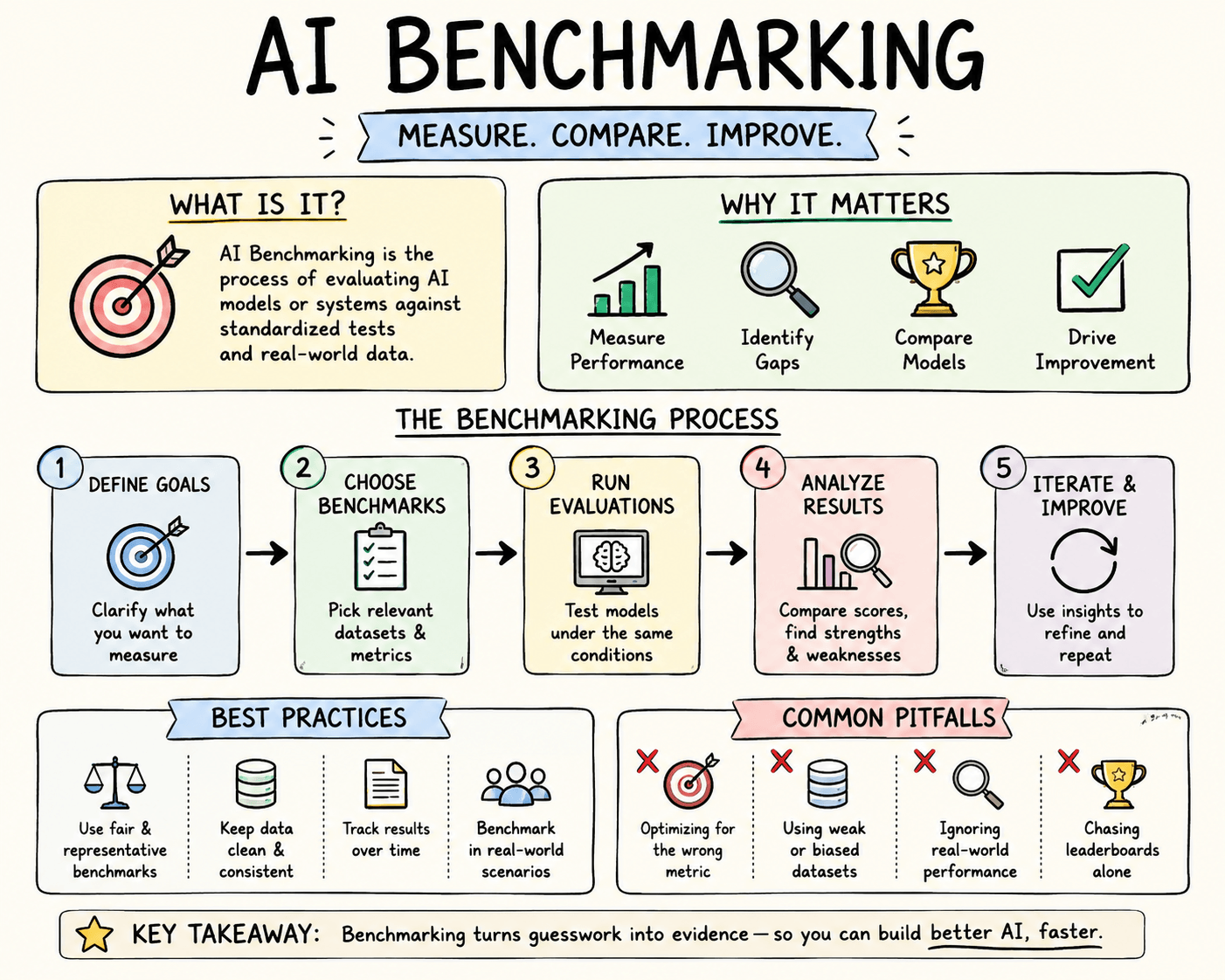
3. Datasets and reference answers
A benchmark dataset should resemble the intended work. Include representative jurisdictions, document types, lengths, languages, scan quality and difficulty. Use synthetic or properly authorised material where confidentiality prevents use of client files.
A robust test set contains:
- questions and source documents;
- the jurisdiction and date of the legal position;
- expert-validated answer elements or reference answers;
- acceptable alternative analyses where the law or drafting permits them;
- required citations and supporting passages;
- facts and documents the system should identify as missing;
- false premises, contradictory documents and misleading instructions;
- clear scoring rules and automatic disqualifiers; and
- metadata allowing performance to be analysed by task and difficulty.
Legal answers are not always unique. “Gold answer” should not mean one immutable paragraph. It may be better to define required issues, prohibited errors, acceptable conclusions and the evidence supporting each. Reference material must be reviewed when the law or organisational playbook changes.
Protect the test set. If prompts and answers are repeatedly published or used for development, the system may be tuned to the test rather than the underlying task. Keep a separate holdout set for final evaluation and rotate part of it over time.
Example: Building a contract-review benchmark
A benchmark for distribution agreements could include:
- a standard agreement with no major deviations;
- an agreement missing a schedule;
- an amendment changing the notice period;
- a handwritten change on the signature page;
- conflicting termination clauses;
- a false user assumption about governing law;
- a scanned document with poor OCR; and
- an embedded instruction telling the model to ignore the playbook.
The reference answer should define which issues must be found, which conclusions are acceptable, which sources must be cited and which errors cause automatic failure.
Case study: The benchmark has leaked into development
A vendor repeatedly tunes its prompt against the same 100 published test matters. Its score rises from 76% to 94%. On a fresh holdout set, performance remains at 78%.
The system has learned the benchmark rather than the broader task. A protected holdout set helps distinguish genuine improvement from test-specific tuning.
4. Metrics and scoring
Choose metrics that reflect actual harm and usefulness:
- Legal and procedural accuracy: correct law, jurisdiction, forum and steps.
- Factual and source fidelity: claims, quotations and summaries match the supplied record.
- Citation validity: authorities exist, are current and support the proposition.
- Issue recall: material issues are found, including exceptions and adverse points.
- Precision: the system avoids irrelevant or false issues that waste review time.
- Completeness: required clauses, documents or questions are not silently omitted.
- Uncertainty handling: missing information and unsettled positions are identified rather than guessed.
- Instruction and format compliance: scope, length, fields and restrictions are followed.
- Robustness: performance survives false premises, hostile document text and unusual drafting.
- Fairness: results do not vary unjustifiably across relevant groups, languages or parties.
- Operational value: latency, cost, reviewer time, correction rate and user completion rate.
Weight errors by consequence. An invented authority or missed limitation issue should not be averaged away by excellent formatting. Define automatic failures for errors that make an output unusable.
Example: Why averaging can mislead
A research system receives:
- 10/10 for formatting;
- 9/10 for clarity;
- 9/10 for speed; and
- 0/10 for citation validity because it invented the leading authority.
A simple average gives 70%. That number suggests partial acceptability even though the output is unusable for legal research.
A better scoring rule may treat fabricated authorities, missed limitation issues, confidentiality breaches and unauthorised external actions as automatic failures.
5. A sound benchmark method
- Define the user, task, inputs, permitted sources and intended use.
- Define acceptance criteria before seeing model outputs.
- Freeze or record the prompt, model version, provider, settings, retrieval configuration and tools.
- Run parsing and retrieval tests separately where documents are involved.
- Run generative tests more than once to measure variation.
- Randomise output order and blind expert reviewers where practical.
- Use at least two reviewers for subjective criteria and reconcile significant disagreement.
- Report results by task and error category, not only as one average.
- Record cost, latency and review effort.
- Retest after any material model, prompt, source or workflow change.
A seed may reduce variability for a particular model and provider, but it does not guarantee identical output and does not make different models comparable. Repeated trials are more informative.
Case study: One good run creates false confidence
A model is tested once on 20 contract questions and scores 90%. When the same questions are run five times, the score ranges from 72% to 91% because different clauses are omitted across runs.
The single run concealed instability. Repeated trials reveal whether the workflow is consistently reliable or merely capable of producing a good answer occasionally.
Example: Reviewer disagreement
Two senior lawyers score the same AI-generated memorandum differently. One gives 8/10 because the conclusion is commercially sensible. The other gives 5/10 because the authority cited does not directly support the proposition.
The disagreement may indicate that the rubric is vague. Reviewers should know whether they are scoring legal correctness, commercial usefulness, drafting quality or all three separately.
Adversarial and safety testing
Include documents containing false instructions, requests to reveal another matter, unsupported pressure for a preferred conclusion, fake citations, manipulated metadata and attempts to trigger unauthorised tools. Test whether the system stops safely when required sources or permissions are absent.
For a short screening exercise focused on practical legal competence, see Benchmarking Legal AI using ROHAS.
6. Build, buy and vendor selection
Buying can provide mature integrations, support and faster deployment. Building can offer greater control over data, workflows and specialised knowledge. A hybrid approach may use a commercial model or research service inside a firm-controlled application.
Compare options against the same requirements:
- performance on your benchmark and documents;
- source coverage and jurisdiction support;
- data use, retention, residency and subprocessors;
- access control, matter isolation and audit capability;
- integration with document, knowledge and case systems;
- ability to export data, logs and work product;
- model transparency, update notices and configuration control;
- total cost, including implementation and lawyer review;
- support, uptime, incident response and exit arrangements; and
- whether the workflow can be disabled or rolled back safely.
A polished demonstration is not a benchmark. Ask vendors to run agreed tests on representative material and explain failures, not merely present selected examples.
Case study: The vendor demonstration
A vendor demonstrates flawless analysis of a clean, ten-page agreement selected in advance. The firm's actual work includes scanned amendments, inconsistent schedules, multilingual emails and 500-page data rooms.
During a controlled test on representative material, the system:
- misses one handwritten amendment;
- misreads a damages table;
- cannot filter by matter permissions; and
- offers no exportable audit trail.
The demonstration proved that the product can succeed on a selected example. The benchmark tested whether it fits the firm's work.
Example: Build, buy or hybrid
A firm wants an internal precedent-search tool.
- Buy: faster deployment and vendor support, but less control over retrieval design and provider changes.
- Build: greater control over permissions, source ranking and internal taxonomies, but higher implementation and maintenance burden.
- Hybrid: a commercial model and search service inside a firm-controlled matter and audit layer.
The right choice depends on benchmark performance, data requirements, integration complexity, operating capability and exit risk.
7. Pilot and deployment
Begin with a bounded task that is frequent enough to measure, valuable enough to matter and safe enough to supervise. Contract clause extraction, internal precedent search or first-pass chronology generation may be more suitable than autonomous client advice.
A practical lifecycle is:
- Map the current process: people, documents, systems, time, errors and approvals.
- Define the target: what improves, what must not change and what remains a lawyer decision.
- Assess risk: confidentiality, data protection, professional duties, security and consequences of error.
- Configure and test: prompts, sources, permissions, guardrails and benchmarks.
- Pilot: use a small trained group and parallel review without allowing unapproved external reliance.
- Measure: accuracy, omissions, review time, correction rate, cost and user behaviour.
- Approve and train: document the permitted use, reviewer responsibilities and escalation path.
- Deploy gradually: expand only when evidence supports the next risk level.
Case study: Piloting chronology generation
A disputes team pilots AI-generated chronologies on 30 closed matters. For the first phase, the AI chronology is created in parallel with the lawyer's ordinary process and is not used externally.
The team measures:
- events correctly identified;
- material events omitted;
- incorrect party or date attribution;
- time required for lawyer verification;
- corrections per matter; and
- whether reviewers can trace each event to a source.
The pilot shows that the system reduces initial preparation time by 45% but regularly misses events contained in image-only attachments. Deployment is approved only after the ingestion pipeline is improved and a scan-completeness check is added.
8. Monitoring and value
Deployment is not the end of evaluation. Models, providers, law, templates, staff and document populations change. Monitor:
- material errors and near misses;
- lawyer overrides and the reasons for them;
- retrieval failures and missing-source events;
- provider or model changes;
- latency, cost and availability;
- permission violations and security alerts;
- performance by task, language and jurisdiction; and
- whether users are applying outputs outside the approved scope.
Measure value against the original process. Token cost alone is misleading. Include licensing, integration, data preparation, training, supervision, corrections, security and governance. Benefits may include faster turnaround, more consistent issue coverage, better knowledge reuse & improved source traceability and not simply fewer lawyer hours.
Case study: Faster output, slower review
A new due-diligence tool cuts first-draft report time from six hours to one hour. Reviewers, however, spend an additional four hours checking false positives and tracing unsupported statements.
The visible generation time improved by five hours, but total professional time improved by only one hour. If licensing, integration and training are added, the workflow may not yet deliver positive value.
Example: Monitoring reveals scope creep
A tool approved for internal contract summaries is gradually used by staff to generate client advice and draft negotiation positions. Error rates have not changed, but the consequences of error have.
Monitoring should examine how the system is actually used, not only whether it remains technically available. Scope drift may require retraining, permission changes or a new approval process.
Case study: A provider update causes performance drift
After a model update, the system's average response time improves and cost falls. At the same time, issue recall on indemnity clauses drops from 91% to 74%.
Operational improvement has masked legal degradation. Monitoring should preserve task-level accuracy measures so that faster and cheaper output is not mistaken for better performance.
9. Starting with AI Blueprint
AI Blueprint Mini and Max are open-source examples for exploring these ideas. They should be evaluated under the same standards as any other tool.
AI Blueprint Mini
AI Blueprint Mini is a single-file browser application. The user supplies an OpenRouter key, describes a task and may upload documents. It runs a four-stage process covering intake, document analysis, work-product generation and AI quality review.
The final AI review is a useful critique step, not independent legal verification. Before using client data, users should understand browser storage, OpenRouter and downstream provider terms, and the absence of the broader matter, access-control and governance features expected in an organisational deployment.
AI Blueprint Max
AI Blueprint Max is the fuller workspace, with workspaces and matters, documents, permissions, workflows, audit trails, personas, voice features, and local and cloud RAG options.
Start with a non-confidential test matter, define the expected output, run a benchmark and inspect the sources and logs. That practical exercise brings together the central lesson of this series: trustworthy Legal AI is not a model choice. It is a legal process designed around evidence, controls, testing and accountable human judgment.
Practical exercise: Benchmarking AI Blueprint
Create a synthetic contract matter containing:
- one main agreement;
- one amendment changing a key clause;
- one missing schedule;
- one scanned page with a handwritten alteration;
- one misleading user assumption; and
- one embedded prompt-injection attempt.
Before running the workflow, define the issues it must identify, the documents it must cite, the facts it should request and the errors that cause failure. Then inspect not only the final answer, but also the retrieved sources, omitted material, logs and reviewer corrections.